

Reviewed · OLD TBILISI WALKING TOURS
Very Friendly Tbilisi Walking Tour (wine tasting & cable car)
Tbilisi gets clear when you walk it. This small-group tour (max 15) is built for first-timers, pairing key old-town stops with a big view moment: the cable car ride up to the Narikala fortress area. You get a local guide, bottled water, and a route that keeps moving without feeling chaotic.
The trade-off is time. Many of the stops are quick photo-and-stories breaks (often around 10–20 minutes), so if you want to linger like a museum person, this may feel a little time-boxed.
In This Review
- Key highlights you’ll feel on the ground
- Price and value: $27.24 for a lot of walking + a cable car
- The meeting point flow: Pushkin Square to a historic finish by Orbeliani Bazaar
- Stop-by-stop: what each place is really for (and what to watch out for)
- 1) Tbilisi Wall Ruins: Old customs gate vibes, short visit
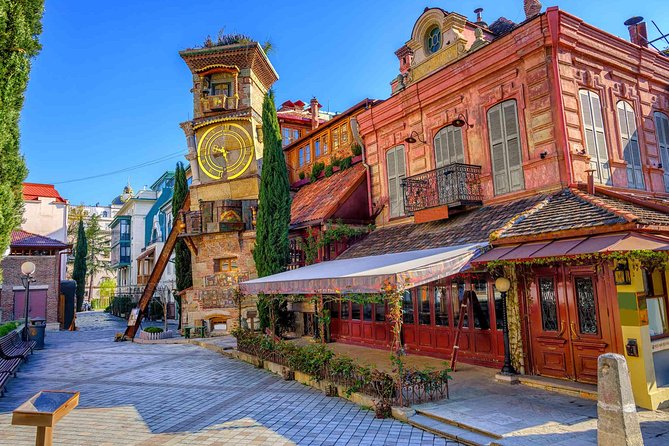
- 2) Rezo Gabriadze Marionette Theater: the angel clock moment
- 3) Anchiskhati Basilica: one of the oldest church buildings in Tbilisi
- 4) Patriarchate of Georgia at Erekle II Square: palace leftovers under church authority
- 5) Peace Bridge: the photo moment with serious design credits
- 6) Rike Park: Georgia-in-a-parks-map idea
- 7) Metekhi Cathedral: St. Shushanik’s tomb ties the place together
- 8) Monument of King Vakhtang Gorgasali: a quick myth-to-king moment
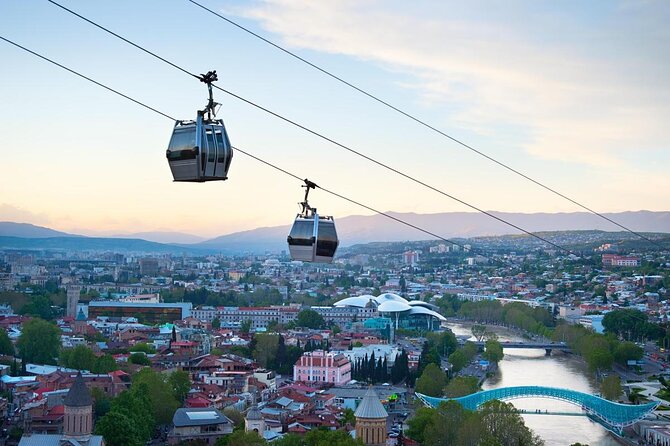
- 9) Aerial Tramway to Narikala: the included ride you’ll be glad you didn’t walk
- 10) Kartlis Deda (Mother of Kartli): wine for guests, sword for enemies
- 11) Narikala Fortress: the long timeline on one hill
- 12) Juma Mosque (Tbilisi Mosque): the city’s only Muslim shrine
- 13) Leghvtakhevi Waterfall: a 22-meter drop in the old city
- 14) Abanotubani: sulphur baths district at Narikala’s foot
- 15) Chreli Abano: a popular sulphur-bath stop
- 16) Meidan Bazaar: wine and souvenirs in the center of old Tbilisi
- 17) Shardeni Street: pedestrian galleries, cafes, and social life
- 18) Sioni Cathedral: a 5th-century cross-domed church with modern importance
- When this tour is the right choice (and when it isn’t)
- Should you book the Very Friendly Tbilisi Walking Tour (wine tasting & cable car)?
- FAQ
- How long is the tour?
- Where does the tour start and end?
- What does it cost per person?
- Is the cable car included?
- Are any tickets for the stops required?
- What’s included in the tour price?
- What is not included?
- How big is the group?
- What about cancellation?
- Do children need to be with an adult?
Key highlights you’ll feel on the ground
- Small-group pacing (max 15): easier questions, fewer shoulder-to-shoulder moments.
- Cable car included to Narikala: connect Rike Park/Europe Square to the fortress area with minimal effort.
- Animated puppet-theater detail: Rezo Gabriadze’s clock tower releases a golden angel each hour.
- Peace Bridge design bragging rights: opened May 6, 2010, tied to architect Michele de Luca and lighting by Philippe Martino.
- Sulphur-bath district stop: Abanotubani puts you at the foot of Narikala, where the city’s famous baths live.
- Free-admission style route: many listed sights show admission as free, which helps stretch your money.
Price and value: $27.24 for a lot of walking + a cable car
At about $27.24 per person for roughly 4 hours, the biggest value is not just the price tag. It’s what you’re bundling: a guided walk with a local guide, bottled water, and at least one transportation element (the Tbilisi cable car).
You’re also getting a “sights first” structure. A lot of the stops on this route list free admission tickets, which means you’re not stacking entry fees on top of your tour cost. That matters in Tbilisi because you may already be spending on taxis or daily activities. This tour is set up to keep the spending mostly predictable.
The one thing to keep in mind: food and drinks aren’t listed as included. The tour name includes wine tasting, so plan on a wine moment, but if you’re picky about what’s covered (and how much), it’s smart to confirm what portion of tasting is included versus what’s extra. At least the tour itself covers water, so you’re not hunting for a drink the moment you need one.
More Old Tbilisi walking tours through the balconied backstreets

The meeting point flow: Pushkin Square to a historic finish by Orbeliani Bazaar
This tour starts at Tbilisi Pushkin Square and ends near Площадь Орбелиани by Orbeliani Bazaar. That is a practical ending point if you want to keep wandering afterward. It also helps you avoid the “we drop you somewhere random” problem.
You’ll also notice the tour is built for normal visitors, not just hardcore historians. It’s described as near public transportation, service animals are allowed, and kids must be with an adult. In other words: it’s designed to be doable without special prep.
If you’re arranging your day, treat it like your “get my bearings fast” block, not your “deep research in one neighborhood” block.
Stop-by-stop: what each place is really for (and what to watch out for)
1) Tbilisi Wall Ruins: Old customs gate vibes, short visit
You start with the Tbilisi city wall ruins and underground heritage tied to the 11th century, including the Old customs gate area. This stop works as an orientation moment. It’s a reminder that today’s streets sit on layers, and Tbilisi’s story isn’t only visible above ground.
Because the stop is brief (around 15 minutes), you won’t have time to read every detail. The value is the guide’s explanation and the way it sets up what you see later.
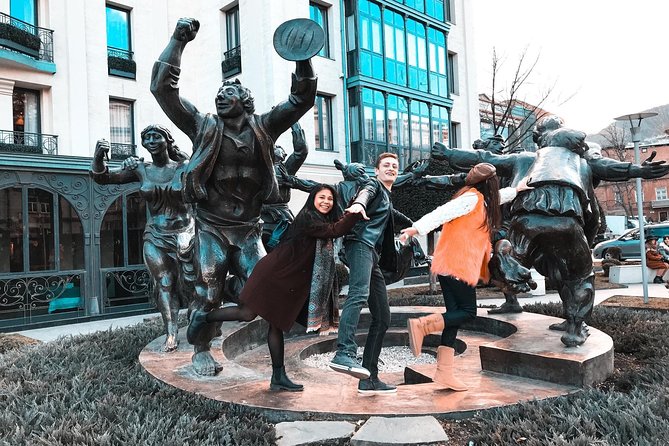
2) Rezo Gabriadze Marionette Theater: the angel clock moment
Next is Rezo Gabriadze’s Marionette Theater on Shavteli Street. It’s noted as the first Georgian puppet theater in Tbilisi, built in 1981, with a distinctive look and a clock tower face added in 2010.
Here’s the fun practical detail: once an hour, a golden angel comes out of the painted doorway and rings a bell with a small hammer. If you hit the timing right, you get an extra “wow” without paying for anything new.
The only drawback is timing. If your arrival doesn’t line up with the hour mark, you’ll still see the building and get the story, but the show-and-clock effect may be missed.
More Tbilisi wine cellars and tasting rooms we have sat down in


3) Anchiskhati Basilica: one of the oldest church buildings in Tbilisi
Then you walk to Anchiskhati Basilica (Anchiskhati Cathedral). This is a three-nave basilica dating back to the 6th century, described as the oldest church building in Tbilisi.
If you like details, this stop has a strong thread: the church’s current name ties to an icon connected to the Savior brought in 1664 from Anchi Monastery in South Georgia. The icon of the Savior of Anchi is connected to Georgian craftsmanship and is kept at the Georgian National Museum.
You’ll only have about 10 minutes, so come in ready to catch the highlights. The real payoff here is understanding why locals treat these places as living anchors, not just old stone.
4) Patriarchate of Georgia at Erekle II Square: palace leftovers under church authority
From there you reach the Patriarchate of Georgia area on the eastern side of Erekle II Square. The important context is that there used to be a palace of King Rostom here, and the present building began in 1809 on ruins linked to Tsarist Russia.
This stop is more about layers of power than about a single architectural masterpiece. It helps you see how Russian Orthodox institutions, government, and older royal space all overlap in one place.
5) Peace Bridge: the photo moment with serious design credits
Now you cross the vibe into modern Tbilisi at the Bridge of Peace (Peace Bridge). It sits on the Mtkvari River, between the Metekhi and Baratashvili bridges, connecting Erekle II Street and Rike.
This bridge is a symbol of renewed Tbilisi, officially opened May 6, 2010. And it has names attached that you can actually repeat later: architect Michele de Luca and lighting designer Philippe Martino (also tied to the MIA building, the Presidential Palace, and the TV tower).
The stop itself is short (around 15 minutes), but it’s the kind of place where the guide can point out lines, angles, and how the city has reshaped itself along the river.
6) Rike Park: Georgia-in-a-parks-map idea
Right by the river, you spend time in Rike Park. It’s described as one of the newer, artistically appointed parks in central Tbilisi, with pathways that, when viewed from above, form a large-scale map of Georgia.
This is one of those “use your eyes” stops. Even in a brief visit, you can appreciate how modern design tries to reflect national geography.
7) Metekhi Cathedral: St. Shushanik’s tomb ties the place together
Next: Metekhi Cathedral (Church of the Nativity of the Virgin Mary) in the historical Metekhi district on the left bank of the Mtkvari. The guide’s focus here should be the tomb of St. Shushanik, with remains transferred to this temple after an early 7th-century ecclesiastical split.
You also get a royal detail: it’s known that Queen Tamar adorned the body with gilded clothes and paid special homage. Even with a quick stop (about 15 minutes), those names make the church feel specific, not generic.
8) Monument of King Vakhtang Gorgasali: a quick myth-to-king moment
You then see the Monument of King Vakhtang Gorgasali, tied to Vakhtang I of the Chosroid dynasty (2nd half of 5th to early 6th century). His reign is described as hard to date, but the story is clear: alliance with the Byzantine Empire, conflict against Sasanian Iranian hegemony, and his defeat that weakened the kingdom of Iberia.
This is a shorter stop (about 5 minutes). The point isn’t to memorize dates—it’s to recognize the king and understand why his name shows up in Tbilisi symbols.
9) Aerial Tramway to Narikala: the included ride you’ll be glad you didn’t walk
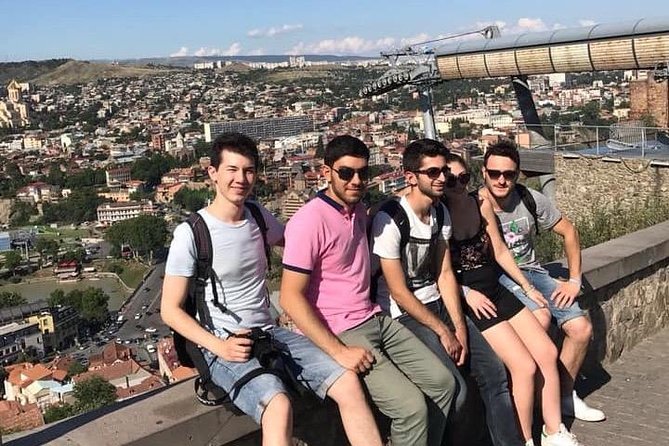
Now comes one of the best practical parts of the tour: the Tbilisi Cable Car ride. It connects Rike Park (Europe Square area) to the fortress of Narikala.
Even if you like walking, this included ride is a value play. It reduces fatigue and gives you views and perspective while you transfer from the river area to the hilltop fortress zone. The listed tram time is about 10 minutes, so it fits the tour pacing without dragging.
10) Kartlis Deda (Mother of Kartli): wine for guests, sword for enemies
You stop at Kartlis Deda, a monumental “Mother of Kartli” statue, one of Tbilisi’s symbols. The statue holds a wine glass for guests in one hand and a sword for enemies in the other.
This is a great stop for understanding Georgian national character through imagery. It’s simple, readable, and easy to connect back to the wine culture you’ll notice later in the day.
11) Narikala Fortress: the long timeline on one hill
Next is Narikala Fortress area, tied to Mtatsminda. The fortress fragments are described as dating to the 4th century AD, with expansions later. Arabs also did work in the 7th–8th centuries, and the modern condition is described as an example of Arabian fortification.
Also worth knowing: the fortress territory contains St. Nicolas temple dated to the 12th century.
You’ll have about 20 minutes here. This is enough time for big-picture impressions and photos, but not long enough for a slow wander with deep reading. If you want that, plan to return on another day.
12) Juma Mosque (Tbilisi Mosque): the city’s only Muslim shrine
Below Narikala Fortress you visit Juma Mosque, currently described as the only Muslim shrine in the city. The first Sunni mosque here dates to 1723–1735 built by Ottomans, later destroyed by Persians in the 1740s, then rebuilt (1846–1851) by architect Giovanni Scudieri.
By 1895, it was renovated by millionaire philanthropist Hajizinelabdin Tagiyev, altering the eastern part. This is one of the stops that makes Tbilisi feel like a city of overlapping eras, not a single narrative.
13) Leghvtakhevi Waterfall: a 22-meter drop in the old city
Back down in the old city, you reach Leghvtakhevi Waterfall, described as 22 meters tall. The name comes from Georgian word “Leghvi,” meaning fig, with historical fig trees nearby. The district Kala is described as separated from the main city by the gorge.
The stop is short (about 10 minutes). You’re mostly there to see the feature and get the story of why a waterfall lives in the middle of an old urban fabric.
14) Abanotubani: sulphur baths district at Narikala’s foot
Then comes Abanotubani, Tbilisi’s historic sulphur-bath district at the eastern bank of the Mtkvari River, at the foot of Narikala. The rise of the baths is tied to hot sulphur springs, with baths built across the 17th–19th centuries. The oldest mentioned is the Irakli bath, with ownership disputes involving imperial family and Georgian princes in the 16th century.
This is one of those areas where the guide’s storytelling matters, because you’re looking at everyday life and long-term tradition more than a single landmark.
You’ll spend about 30 minutes here, which is longer than many other stops, and gives you time to feel the district’s mood and architecture.
15) Chreli Abano: a popular sulphur-bath stop
You also pass by Chreli Abano, described as a popular sulphur bath area that looks like a mosque. This works as an easy “I saw it” stop, even if you’re not booking a bath session.
The only consideration: the listing says admission is free, but baths themselves can involve paying once you decide to use facilities. So think of this as a visual and cultural visit unless you confirm what’s covered for you.
16) Meidan Bazaar: wine and souvenirs in the center of old Tbilisi
You finish the older-market stretch at Meidan Bazaar. The spot is described as historically a commercial square under different names like Shaitan Bazaar and Tatris Moedani.
This is where your day ties back to food and drink culture. If the tour includes wine tasting, this is a logical place for it, since the area is the center where you can buy traditional Georgian wine, souvenirs, and delicacies. Just remember the tour is explicit that food and drinks aren’t listed as included, so treat tastings as something to verify.
The stop is about 20 minutes, enough to browse without getting stuck for hours.
17) Shardeni Street: pedestrian galleries, cafes, and social life
Then you walk Jan Shardeni Street (Shardeni Street). It’s a small pedestrian street known for being one of the city’s cultural and social centers. After reconstruction in the 19th century, it was named after French traveler Jean Chardin.
It’s also lined with galleries and cafes along with nearby parallel pedestrian streets. This is a good place to pause, people-watch, and decide if you want to continue your evening on foot.
18) Sioni Cathedral: a 5th-century cross-domed church with modern importance
Finally, you reach Sioni Cathedral Church (Assumption of the Blessed Virgin Mary). It’s described as a cross-domed temple dating back to the 5th century to the present, and since 1920 it has been the Patriarchal Cathedral.
You’ll have about 10 minutes. The guide’s best move here is to connect architectural style with current religious importance, so it feels relevant instead of just ancient.
When this tour is the right choice (and when it isn’t)
This is a strong fit if you:
- Want a first-timer orientation to Tbilisi without building your own route.
- Like the idea of hitting old churches, fort-like viewpoints, and modern bridge architecture in one go.
- Enjoy a small group where the guide can give context.
- Prefer a guided pace with lots of short stops rather than one long museum session.
I’d think twice if you:
- Hate rushed visits and want more than 10–20 minutes per stop.
- Want only one theme (like only churches, only markets, or only history). This tour mixes it all.
- Are expecting food to be fully covered. The tour includes water, but food and drinks aren’t listed as included.
Should you book the Very Friendly Tbilisi Walking Tour (wine tasting & cable car)?

Yes, if you want an efficient, friendly way to get the lay of the land, especially the Narikala area via the included cable car. The route is built around recognizable Tbilisi moments (Peace Bridge, Rike Park, Narikala, Abanotubani, Shardeni Street) and a few specific details that make the city feel lived-in, like the puppet theater’s hourly golden angel and the story behind St. Shushanik at Metekhi.
Just go in with the right expectations: it’s a walking-and-seeing plan, not a slow sit-down tour. And because the listing says food and drinks aren’t included, treat the wine portion as something to confirm so there are no surprises.
If you’re the type who likes to mix viewpoints with culture, this tour is a good value bet for your first day or your first full morning in Tbilisi.
FAQ
How long is the tour?
It’s listed as about 4 hours.
Where does the tour start and end?
It starts at Tbilisi Pushkin Square and ends near Площадь Орбелиани by Orbeliani Bazaar.
What does it cost per person?
The price is listed as $27.24 per person.
Is the cable car included?
Yes. The Aerial Tramway in Tbilisi (cable car) is included.
Are any tickets for the stops required?
The listed admission for the stops is free at each location shown in the tour outline.
What’s included in the tour price?
The tour includes bottled water and a local guide.
What is not included?
It lists food and drinks, and hotel pickup and drop-off as not included.
How big is the group?
The tour is a small-group experience with a maximum of 15 people.
What about cancellation?
You can cancel for a full refund if you cancel up to 24 hours before the experience start time. Free cancellation is available.
Do children need to be with an adult?
Yes. Children must be accompanied by an adult.
More Narikala and Mtatsminda Cable-Car Views


More Tbilisi Wine Cellars and Tastings

More Old Tbilisi Walking Tours


Not quite your thing? More Tbilisi tours and day trips from our review desk






Old Tbilisi Walking Tours, compared.
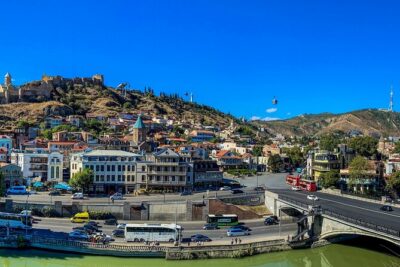 ★ 5.0Tbilisi Walking Tour Including Cable Car and Traditional BakeryFrom $191,310 reviews
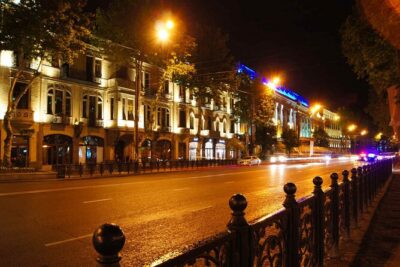 ★ 5.0Evening Walking & Talking Tour with Wine & Boat RideFrom $10572 reviews
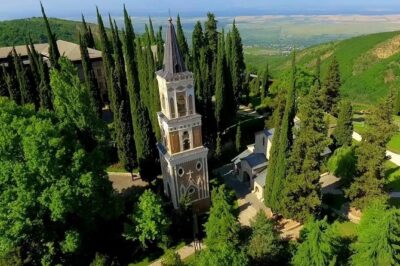 ★ 5.0Kakheti;City of Love Sighnaghi, Bodbe. KTW. Wine House Group tourFrom $16376 reviews
 ★ 5.0Old Tbilisi Highlights walking tour with wine & 10 tastingsFrom $15276 reviews
 ★ 5.0Old Tbilisi Tour: Private Walking Tour With Wine TastingFrom $39273 reviews
 ★ 5.0Private Tbilisi Food Tour: 9 Tastings Walk in Bohemian DistrictFrom $79227 reviews
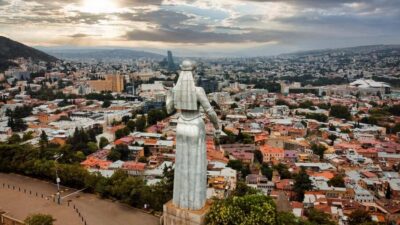 ★ 5.0Old and New City Guided Tour with 2 Cable Car RidesFrom $39176 reviews
 ★ 5.0Tbilisi Old Town Walking Tour with a Local GuideFrom $38168 reviews
Browse the lists this tour appears in