
Reviewed · OLD TBILISI WALKING TOURS
Tbilisi Walking Tour with Cable Car, Wine Tasting & Bread Bite
Tbilisi rewards the slow traveler, and this tour is built for it. You’ll get a private route through Old Town landmarks, then a cable car ride to the Mother of Kartli monument for big panoramic views, plus included Georgian wine tasting and a bread bite. I also like that the pace stays human, with time for breaks and the guide staying on schedule.
My favorite part is how the day stitches together Tbilisi’s layers: medieval churches, Russian-era changes, Soviet-era details, and modern city icons—without feeling like a textbook. The one real drawback is that you’ll deal with stairs and uneven terrain, so comfortable shoes matter, and church dress rules can take a little planning.
In This Review
- Key highlights you’ll feel right away
- A 4-hour Old Town loop that actually makes sense
- Private pickup, air-conditioned comfort, and the guide factor
- Old Town Tbilisi: your orientation shortcut through the centuries
- Metekhi Cathedral: history you can spot without a lecture
- Cable car to Mother of Kartli: views, sculpture symbolism, and a quick reset
- Narikala Fortress: an old citadel with modern-city sightlines
- Sulfur baths and Leghvtakhevi Waterfall: the sensory pause in the middle
- Jvaris Mama and Sioni Cathedral: two church stops that show different eras
- Rezo Gabriadze Marionette Theater: the quirky clock ritual
- Anchiskhati Basilica: the oldest surviving church and the icon story
- Bridge of Peace finish and the option to add a river boat ride
- Wine tasting and bread bite: small stops, big payoff
- Price and value: is $77.50 a fair deal for 4 hours?
- Who this tour suits best
- Should you book this Tbilisi tour?
- FAQ
- FAQ
- How long is the tour?
- Where in Tbilisi does the tour take place?
- Is this tour private?
- Do I get pickup and transportation?
- Is the cable car included?
- Is wine tasting included, and is there an age limit?
- What should I wear for church visits?
- Will I be walking on uneven ground?
- What happens if the weather is bad or I need to cancel?
Key highlights you’ll feel right away
- Private group attention with a guide who manages time and pacing
- Cable car to Mother of Kartli with panoramic Tbilisi views
- Included Georgian wine tasting and bread bite at no extra cost
- Major historic stops in one 4-hour loop: Old Town, Narikala, multiple churches
- Surprise culture stop at the Rezo Gabriadze Marionette Theater clock ritual
- Easy optional add-on: boat tour on the Mtkvari River for an extra charge
A 4-hour Old Town loop that actually makes sense
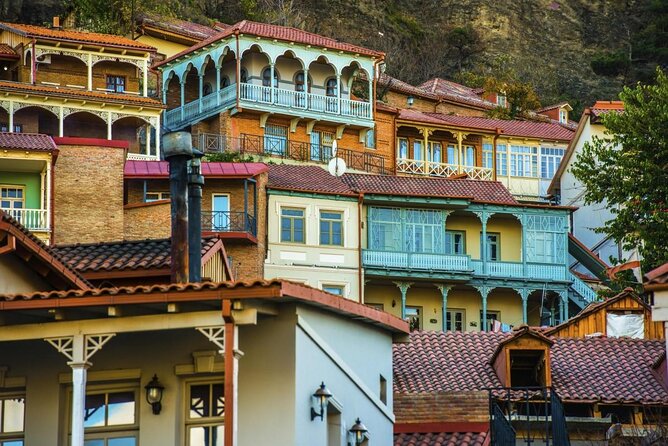
This is the kind of walking tour that helps you get oriented fast. Tbilisi sits on the banks of the Kura River, and the city has been a crossroads of power for centuries—because it sits between Europe and Asia and sits close to the Silk Road. You’ll see that mix in the architecture, which ranges from medieval styles to neoclassical and modern-era buildings.
In just about four hours, you cover the sights people expect plus a few details that help the city feel lived-in. The route also keeps you moving in a logical flow: ground-level historic streets, then viewpoints, then more landmark churches, and finally a modern walk by the river.
More Old Tbilisi walking tours through the balconied backstreets


Private pickup, air-conditioned comfort, and the guide factor
Even though it’s a walking tour, you’re not stuck doing everything on foot from minute one. The tour offers pickup, and you travel in an air-conditioned vehicle between key points. That matters in Tbilisi—weather and walking heat can change fast—so having a car reset between neighborhoods makes the day easier.
This is also a private tour/activity, so you’re only with your group. That means your guide can tailor pacing to your comfort level, and you’re not stuck waiting for strangers who move slowly (or rush ahead).
In my experience, the guide experience is a major part of the value. My guide George did a great job keeping the timing tight while still making sure we could rest when we needed it. That balance is what turns a list of landmarks into something you actually remember.
Old Town Tbilisi: your orientation shortcut through the centuries
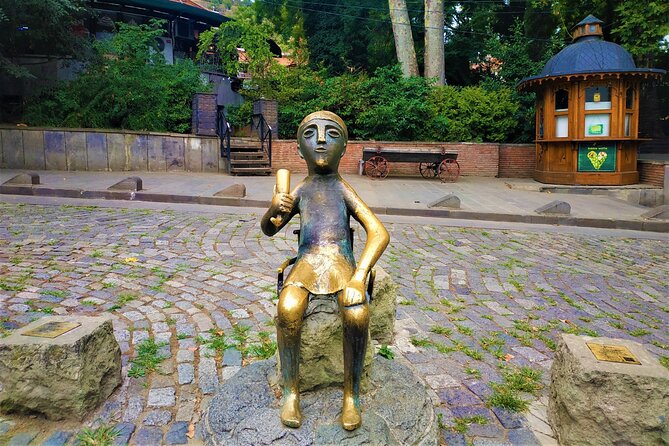
Old Town is where the tour begins, and it sets the tone. Tbilisi was founded in the 5th century AD by Vakhtang I of Iberia, and over time the city became a contested point because of its crossroads location. You’ll see that story reflected in the mix of architectural styles—medieval, neoclassical, Beaux Arts, Art Nouveau, Stalinist, and modern structures.
This first stretch helps you connect the dots. Instead of walking in random circles, you’re walking with context: why this street layout exists, why the buildings look the way they do, and why the city’s religious buildings feel like anchors.
One practical plus: many of the key church stops here are listed as free admission, so you’re not paying again and again just to enter.
Metekhi Cathedral: history you can spot without a lecture
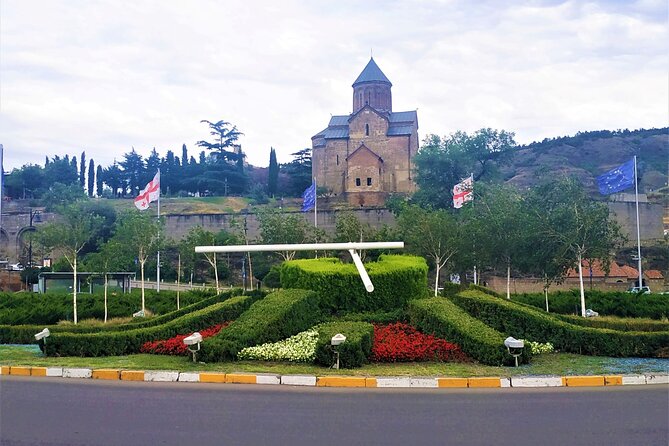
Next you’ll visit Metekhi Cathedral, the Church of Assumption area. The church was built by Georgian king St Demetrius II (1278–1284) and later faced damage and restorations over the centuries. Under Russian rule (starting in 1801), the church shifted from religious use to military functions, and a jail replaced parts of the old citadel structure down into Soviet times.
One detail I find useful here: the statue of King Vakhtang Gorgasali by sculptor Elguja Amashukeli was erected in 1961, so it gives you a visible bridge between different eras of Georgian identity.
You’ll spend about 20 minutes here—enough time to look around and read the mood of the place, without dragging.
Cable car to Mother of Kartli: views, sculpture symbolism, and a quick reset
Then comes the aerial tramway. The cable car ride takes you up to the Mother of Kartli monument, erected in 1958 when Tbilisi celebrated its 1500th anniversary.
This monument is a 20-meter aluminum figure designed by Elguja Amashukeli. She represents Georgian national character: in her left hand she holds a bowl of wine to greet friends, and in her right hand she holds a sword for enemies. That symbolism matters because it turns the viewpoint into more than a postcard stop—you’re looking at the city through a cultural lens.
You’ll get about 20 minutes here, and it’s built for a breather. Panoramic views of Old Tbilisi are the point. If you’re tired from walking, this is a good moment to cool down and get fresh air while still seeing something major.
More Tbilisi wine cellars and tasting rooms we have sat down in





Narikala Fortress: an old citadel with modern-city sightlines
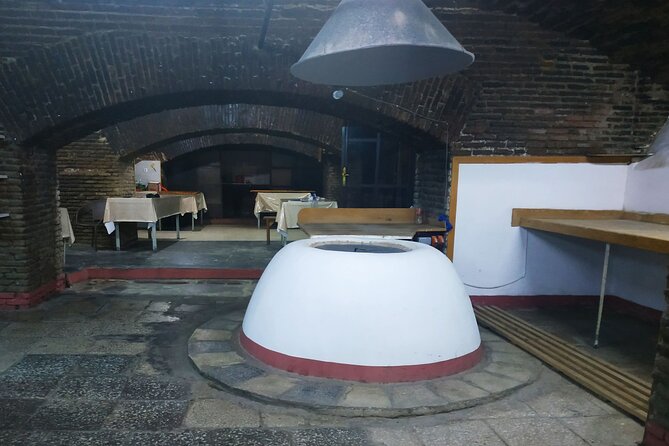
After the viewpoints, the tour moves to Narikala Fortress. It dates back to the 4th century as a Sasanian citadel known as Shuris-tsikhe. Later, King David the Builder expanded it (1089–1125). Even the name evolved: the Mongols renamed it Narin Qala, meaning Little Fortress.
Most of what you’ll see in the existing fortifications dates from the 16th–17th centuries, and the fortress took a hit in 1827 when an earthquake damaged it. The result is a place that feels layered—like you’re standing in a timeline.
You’ll get around 20 minutes here, and the best part is the combination of old stones and big Tbilisi views. The drawback is simple: it’s another uphill-feeling area. Wear shoes that won’t punish you.
Sulfur baths and Leghvtakhevi Waterfall: the sensory pause in the middle
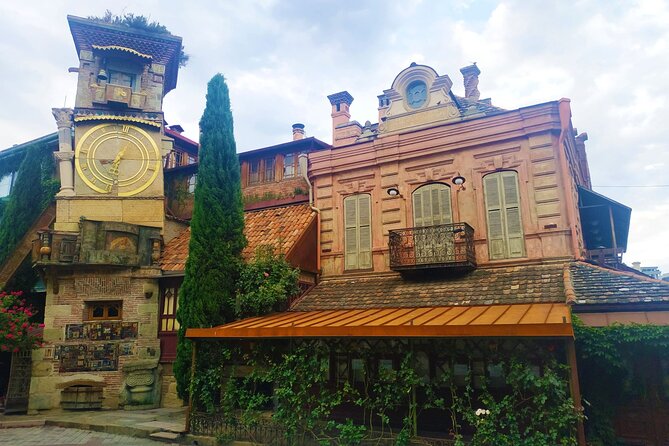
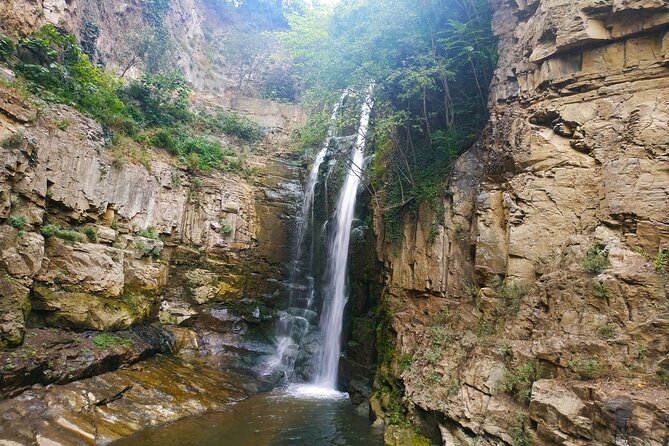
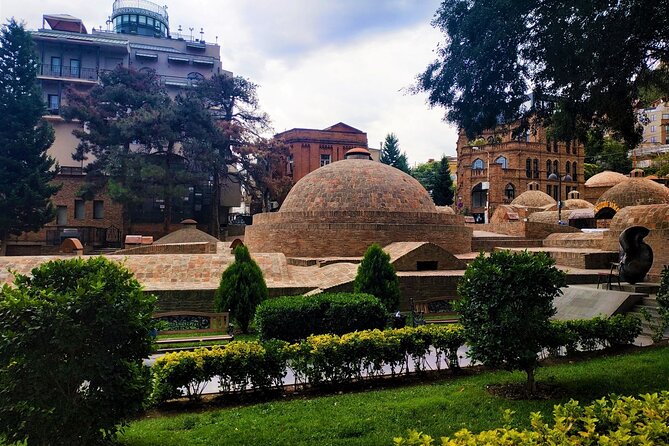
After Narikala, the tour heads to Dzveli Tbilisi Sulphur Waterfall area and the sulfur baths / Leghvtakhevi Waterfall stop. This isn’t just scenery. The sulfur bath thermal springs rise from the ground at around 40–50°C. The listed uses include skin issues, dry scalp, arthritic joints, digestion problems, and insomnia—so you’ll leave with a clear idea why this part of town matters for wellness culture.
You’ll also see Leghvtakhevi Waterfall, which flows from a botanical garden in Tbilisi. It’s a short stop, about 20 minutes, but it changes the mood from stone-and-viewpoint to something more natural and calming.
One thing to note: the tour information frames this as a visit. It doesn’t say you’ll necessarily soak. If you want an actual bath experience, you might need a separate plan in addition to the walk.
Jvaris Mama and Sioni Cathedral: two church stops that show different eras
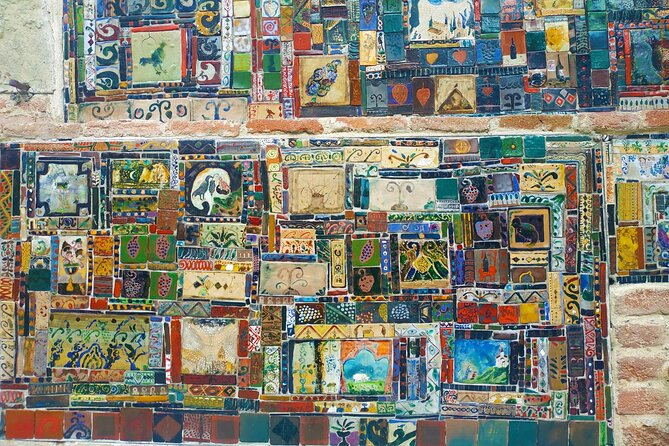
Next you’ll visit Jvaris Mama, also tied to the Cross-cult tradition. King Vakhtang Gorgasali built a saint cross church in the 5th century called Golgotha, linked by legend to St Nino. The current building dates to the 16th century, and it was destroyed and later restored in the 1990s.
This church is described as a chapel-hall style example, and it also includes a local detail: until 1921, the Father of Cross church belonged to the Jerusalem patriarchate, and the Father of Cross is described as cold. Even if you don’t memorize all the dates, it helps you notice how stories travel with buildings.
Then you’ll move to Sioni Cathedral Church, named after Mount Zion in Jerusalem. The original structure dates to the 6th–7th centuries, but it was destroyed and reconstructed multiple times. The present church is based on a 13th-century version with changes from the 17th to 19th centuries, and it was rebuilt by King David the Builder in 1112. It was heavily damaged in 1226 when its dome was ruined on the order of Jalal ad Din.
A useful context detail: Sioni was the main Georgian Orthodox cathedral and the seat of the Catholicos-Patriarch of All Georgia until the Holy Trinity Cathedral was consecrated in 2004. That makes the stop feel important for understanding church power structures—not just architecture.
Both church stops are short (around 10 minutes each), so you’re moving at a thoughtful pace, not touring like a museum.
Rezo Gabriadze Marionette Theater: the quirky clock ritual
One of the more memorable cultural stops comes next: Rezo Gabriadze Marionette Theater. Rezo Gabriadze was a theater and film director, writer, painter, and sculptor, born in 1936, and he founded the theater in 1981. In 2011, a clock tower was added.
On the hour, a window opens, and a mannequin of an angel strikes the bell. Below the clock, a screen opens to show the circle of life: boy meets girl, marriage, childbirth, and funeral.
Even if you only catch a portion, the design is the whole point—this is Tbilisi’s street art-meets-theater mood in a timed ritual.
Anchiskhati Basilica: the oldest surviving church and the icon story
Then you’ll visit Anchiskhati Basilica of St Mary, described as the oldest surviving church in Tbilisi, dating to the 6th century and built by King Dachi. It was originally dedicated to the Virgin Mary. In 1675, it was renamed Anchiskhati (icon of Ancha) when a treasured icon created by the 12th-century goldsmith Beka Opizari was moved to Tbilisi to protect it from an Ottoman invasion.
The church has been damaged and rebuilt several times. A brick belfry was built in 1675, and a dome was added in the 1870s. During Soviet times, it was used as an art studio, and restoration began in the 1950s.
If you like details, this is a strong stop: it’s a three-span basilica, originally yellow stones with brick used for restoration, and the altarpiece is from the 17th century while other paintings date to the 19th century.
You’ll have around 10 minutes here, so I’d treat it as a look-and-learn moment rather than a deep interior study unless you plan to come back later.
Bridge of Peace finish and the option to add a river boat ride
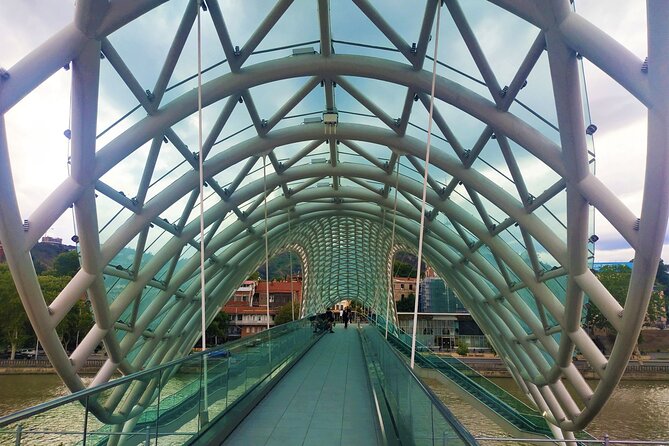
The tour wraps up near the Bridge of Peace, which opened in 2010 and is 150 meters long. The bridge features a marine animal design. It was designed by Italian architect Michele De Lucchi, who also designed Georgia’s Presidential Palace and the Ministry of Internal Affairs.
This final section is a good mental reset. Instead of more religious history, it gives you a modern, human-scale view of the river and the city’s current look.
You can also add a boat tour on the Mtkvari River for an extra charge, if you still have energy at the end.
Wine tasting and bread bite: small stops, big payoff
Your tour includes Georgian wine tasting with no extra cost, plus a bread bite. This is a smart pairing with the rest of the route. Walking through churches and fortresses can make the day feel heavy. Having a taste of something Georgian helps anchor the experience in daily life, not just monuments.
Also, Georgia’s legal drinking age is 18, so if your group includes younger travelers, plan accordingly.
If you’re sensitive to alcohol, don’t worry about it being a forced slog—this is included tasting and a bread bite, not a long alcohol session.
Price and value: is $77.50 a fair deal for 4 hours?
At $77.50 per person, this tour sits in a mid-range zone for a private guided walking experience. What makes it feel like good value is the mix of included items and how much you fit in.
You get:
- a private tour experience
- pickup and travel in an air-conditioned vehicle
- cable car admission included for the Mother of Kartli segment
- Georgian wine tasting at no extra cost
- a route through major Old Town highlights, with many entries listed as free admission
The tour is about 4 hours, so you’re not losing a full day. If you’re visiting Tbilisi for the first time and you want a guide to help you connect the city’s layout and history quickly, this price can feel very reasonable.
The main reason it might not be for you is simple: if you dislike walking with stairs and uneven ground, the experience can start to feel like work rather than discovery.
Who this tour suits best
I’d strongly consider this for:
- first-timers who want a guided way to learn Tbilisi fast
- people who like history but also want practical context
- visitors who want viewpoints and architecture without sorting logistics
- groups who want a private experience rather than a crowded itinerary
I’d think twice if:
- you have mobility limits and stairs are a challenge (the tour includes terrain and stairs)
- you’re visiting during rough weather and can’t adjust plans, since the tour requires good weather
Should you book this Tbilisi tour?
Yes, if your goal is to see the core of Tbilisi in a way that feels organized, not rushed. The standout value is the combination of included cable car views, wine tasting, and a tight loop through major historic sites that are free to enter.
Book it especially if you appreciate a guide who keeps the day moving while still allowing real breaks. And do yourself a favor: bring the right church outfit basics (or plan to get scarves near entrances), wear comfortable shoes, and you’ll get a far more comfortable day.
FAQ
FAQ
How long is the tour?
The tour runs about 4 hours (approximately).
Where in Tbilisi does the tour take place?
It focuses on Old Town and nearby major landmarks, including stops around Metekhi Cathedral, the cable car to Mother of Kartli, Narikala Fortress, several churches, Rezo Gabriadze Marionette Theater, and the Bridge of Peace.
Is this tour private?
Yes. It is listed as a private tour/activity, meaning only your group participates.
Do I get pickup and transportation?
Pickup is offered, and you travel in an air-conditioned vehicle. The meeting area is also near public transportation.
Is the cable car included?
Yes. The aerial tramway to Mother of Kartli has admission included.
Is wine tasting included, and is there an age limit?
Georgian wine tasting is included with no extra cost. The legal drinking age in Georgia is 18.
What should I wear for church visits?
Women need to wear head scarves and dresses in Georgian Orthodox churches. Short trousers for men are forbidden. Scarves and dresses are also available near church entrances.
Will I be walking on uneven ground?
Yes. The tour includes walking in Old Town with various terrain and stairs. Comfortable shoes are recommended.
What happens if the weather is bad or I need to cancel?
The experience requires good weather. If it’s canceled due to poor weather, you’ll be offered a different date or a full refund. You also get free cancellation up to 24 hours in advance for a full refund.
More Narikala and Mtatsminda Cable-Car Views


More Tbilisi Wine Cellars and Tastings

More Old Tbilisi Walking Tours


Not quite your thing? More Tbilisi tours and day trips from our review desk









Old Tbilisi Walking Tours, compared.
 ★ 5.0Tbilisi Walking Tour Including Cable Car and Traditional BakeryFrom $191,310 reviews
 ★ 5.0Evening Walking & Talking Tour with Wine & Boat RideFrom $10572 reviews
 ★ 5.0Kakheti;City of Love Sighnaghi, Bodbe. KTW. Wine House Group tourFrom $16376 reviews
 ★ 5.0Old Tbilisi Highlights walking tour with wine & 10 tastingsFrom $15276 reviews
 ★ 5.0Old Tbilisi Tour: Private Walking Tour With Wine TastingFrom $39273 reviews
 ★ 5.0Private Tbilisi Food Tour: 9 Tastings Walk in Bohemian DistrictFrom $79227 reviews
 ★ 5.0Old and New City Guided Tour with 2 Cable Car RidesFrom $39176 reviews
 ★ 5.0Tbilisi Old Town Walking Tour with a Local GuideFrom $38168 reviews
Browse the lists this tour appears in