

Reviewed · OLD TBILISI WALKING TOURS
Tbilisi Old Town Walking Tour with a Local Guide
One walk can teach a whole city. This Tbilisi Old Town tour strings together church wonders, street-level stories, and modern landmarks without feeling rushed. I like that it keeps your focus tight with a small group size (max 15) and a guide who explains what you’re actually looking at. The one trade-off: it’s weather-dependent, so a rainy day can mean a reschedule.
What I really like is the mix of eras. You’ll see a 6th-century basilica, step into the spiritual complex of Sioni, then cross to the Bridge of Peace—glass and steel over the Mtkvari (Kura) River. Another big plus for me is the “learn as you walk” pacing, with short, high-impact stops and time to ask questions along the way. If you hate stairs or steep bits, plan accordingly since this area is built on hills.
The tour also hits Georgian culture from multiple angles, including the bronze Tamada statue tied to supra (Georgian feast) traditions. There’s also a wine-tasting age rule (18+), so if you want to include that part, be sure everyone in your group meets the minimum age. If you want museum-style depth for hours, you’ll feel the difference—this is meant to get your bearings fast, not replace a full-day deep dive.
In This Review
- Key highlights worth planning around
- Entering Tbilisi Old Town: a smart route, not a random wander
- The guide factor: what small groups change
- Berikaoba sculptures near Dry Bridge: Georgia’s idea of freedom in bronze and stone
- Anchiskhati Basilica: when a 6th-century church is still active
- Bridge of Peace and the river view: modern Tbilisi without leaving the story
- Shardeni Street: the Old Town lane that feels instantly walkable
- Rezo Gabriadze Marionette Theater and the clock tower face-off
- Sioni Cathedral complex: a sacred setting with a name full of meaning
- The Tamada statue: how wine toast culture becomes public art
- Europe Square and EU flags: the politics are visible, not abstract
- Great Synagogue and the Tree of Life: faith and modern reflection
- Rike-Narikala cable car and Kartlis Deda: the viewpoint you’ll actually use later
- Price and value: why $38 can work if you hate guesswork
- Practical tips so you don’t trip over small rules
- Should you book this Tbilisi Old Town walking tour?
- FAQ
- How long is the Tbilisi Old Town walking tour?
- What is the meeting point and where does the tour end?
- Is the tour offered in English?
- Is the cable car included in the price?
- What isn’t included, and how much should I budget for lunch?
- Do churches on the route have free admission?
- Are there restrictions for visiting churches?
- Is there wine tasting on the tour, and what’s the age requirement?
Key highlights worth planning around
- Small-group feel (max 15), which makes questions and photo stops easier to manage
- Historic church stops with real context, including Anchiskhati Basilica and the Sioni complex
- Modern Tbilisi in the middle of the walk, especially the Bridge of Peace and Europe Square
- A cable car segment included, so you get city views without handling the logistics alone
- Culture through symbols, like the Tamada statue and the Tree of Life monument
- Free admission at many key stops, so you can spend your money on food and snacks
Entering Tbilisi Old Town: a smart route, not a random wander
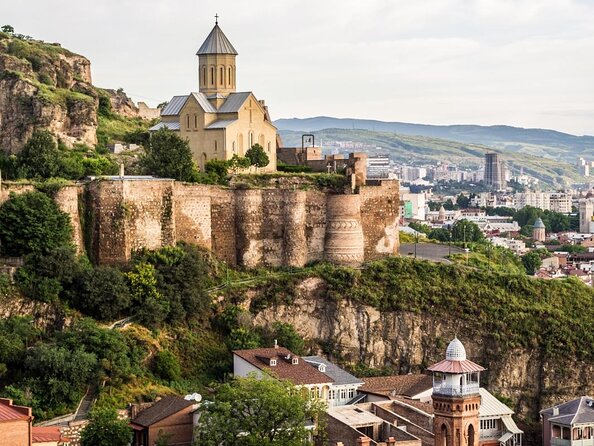
This tour is designed for getting oriented. You start in the Old Town area near 17 Ioane Shavteli St and end at Freedom Square. That matters because you’re not backtracking the whole city—your walking line naturally moves downhill and across key neighborhoods.
The timing is also realistic: about 3 hours 15 minutes including travel time. Stops are short, so you’re not stuck in one place waiting for everyone else. It’s the kind of pace that works well on a first or second day in Tbilisi when you want to understand what’s where before you strike out on your own.
And since the tour is offered in English with a professional guide, you get the benefit of someone pointing out what you’d otherwise miss—little details, architectural clues, and symbolic references. You’ll also get a mobile ticket, which keeps the start smoother and reduces the need to find paper tickets on the street.
More Old Tbilisi walking tours through the balconied backstreets


The guide factor: what small groups change
A walking tour lives or dies by the guide. The best part here is that the tour doesn’t feel like a script read at you. It’s more like an explanation that keeps pace with what you’re seeing right then.
You’ll notice this in the way guides handle questions. People consistently mention the guidance style as engaged and story-driven, with lots of answering rather than one-way talking. Names that come up in feedback include Teona, who’s credited with making Georgian culture and history feel personal and easy to follow. Another guide name you might run into is Monica, praised for explaining major monuments in detail.
The small group limit—15 travelers max—helps this a lot. In a bigger group, questions often go unanswered. Here, you’re more likely to get your follow-up answered while it still feels relevant.
Berikaoba sculptures near Dry Bridge: Georgia’s idea of freedom in bronze and stone
Your first major visual hit is the Sculpture Group Berikaoba near Dry Bridge. The figures are lively and expressive—built to look like movement instead of still poses. That’s not just artistic flair; it’s meant to tie back to the “festival spirit” of freedom and rebellion, honoring Georgian cultural traditions and the power of art to carry messages across generations.
Why this stop works early: it sets the tone for what the tour keeps doing. Instead of treating monuments as “just landmarks,” it points you toward the meaning behind the shapes and scenes.
This stop is also quick—about 10 minutes, with free admission—so you won’t lose momentum at the start. If you’re into street-level art, you’ll probably linger for photos here. Just keep it moving so you don’t compress later stops.
Anchiskhati Basilica: when a 6th-century church is still active

Next comes Anchiskhati Basilica, described as the oldest church building in Tbilisi. Dating back to the 6th century, it’s a three-nave basilica. That architectural form matters: the layout helps explain why basilicas became so influential in Christian building traditions—space and procession designed for communal worship.
This is free to enter, but the tour’s church rules are important. Taking pictures inside churches isn’t allowed, and there’s dress code guidance. The dress code detail can catch people off guard—carry a light layer (or be ready to adjust what you’re wearing) so you’re not worried during the visit.
The value here isn’t just the age of the building. It’s how it anchors you. Once you’ve seen a church that old, the rest of the Old Town makes more sense—the city isn’t only streets and views; it’s also faith, continuity, and changing power over centuries.
Bridge of Peace and the river view: modern Tbilisi without leaving the story
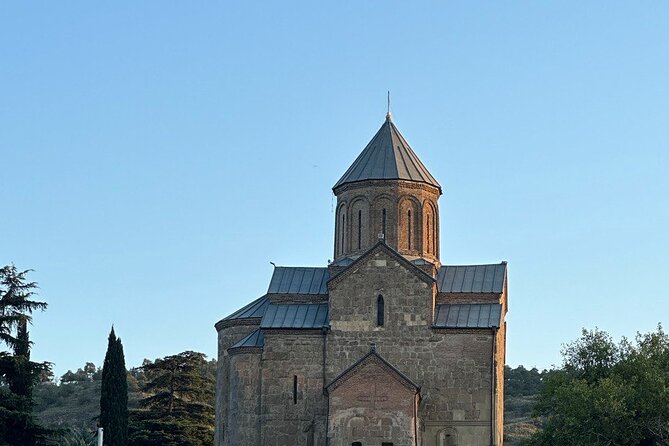
Then you hit one of Tbilisi’s most talked-about modern landmarks: the Bridge of Peace. It’s relatively new, and the design stands out—glass and steel, shaped like a bow, spanning the Mtkvari (Kura) River.
This stop gives you two things. First, a visual reminder that Tbilisi is still actively building and deciding what it wants to represent. Second, it helps your brain connect neighborhoods: once you see the river as a dividing line, you’ll understand later how Old Town streets “work” around water and elevation.
The time here is short—about 10 minutes—and admission is free. That makes it a good fit for a group walk. You get your photo moment and a clear sense of where you are, without turning the tour into a long detour.
More guided Tbilisi tours with a local at the helm





Shardeni Street: the Old Town lane that feels instantly walkable
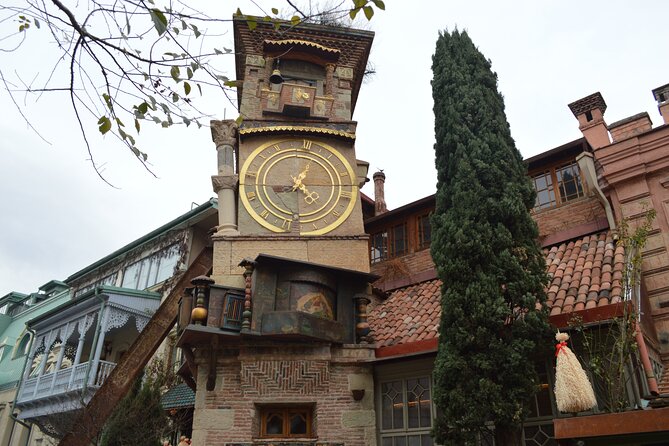
You’ll also pass through Shardeni Street, a small pedestrian-friendly walking street in the Upper Kala district, between Vakhtang Gorgasali square and Sioni Street. This is one of those places where the city’s texture shows up quickly: compact streets, storefront energy, and the sense that this is where people actually stroll.
It’s not framed as a single “must-see monument” stop. Instead, it’s the palate cleanser that turns the tour from “point-to-point history” into something more human. If you’re the kind of traveler who likes to watch how a city sounds and smells, Shardeni Street will land well.
It’s a brief 10-minute segment, and that’s perfect. It’s enough to orient you, but not so much you feel trapped in a single lane.
Rezo Gabriadze Marionette Theater and the clock tower face-off
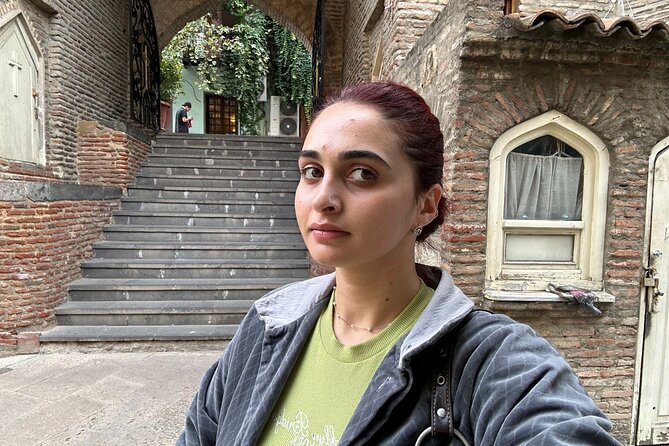
One of the most recognizable visual landmarks on your route is the Rezo Gabriadze Marionette Theater. In front of it stands the clock tower, and the architecture is unusual enough that it’s easy to spot even without perfect directions.
Why this stop is worth your attention: it reinforces the tour’s theme of art and storytelling. Marionette theater is part of Georgian performance culture, and the exterior design gives you that “stage set” feeling—like Tbilisi itself is inviting you to look at crafted forms.
Admission is free, and the stop is about 10 minutes. If you like architecture, arrive with the mindset of noticing how lines and shapes guide your eye. If you don’t, you’ll still get the big idea: this is a cultural landmark, not just a building.
Sioni Cathedral complex: a sacred setting with a name full of meaning
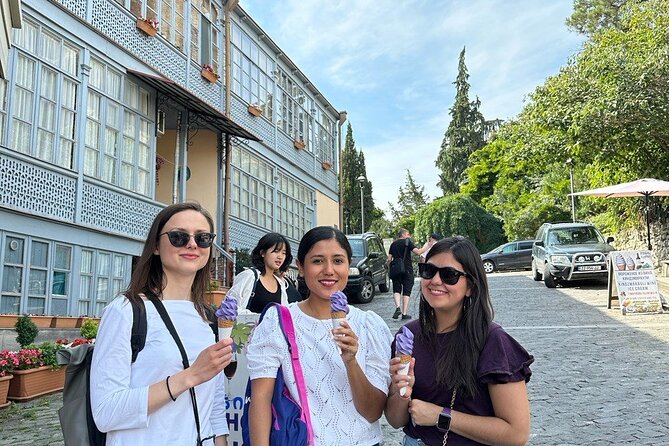
Next is Sioni Cathedral Church, part of a larger complex that includes a fence, the Cathedral of the Assumption, and two bell towers. The name Sioni is linked to a sacred mountain in Jerusalem, and it’s also described as a Hebrew word meaning sunny.
Even if you’re not religious, the complex works as a study in how cities build identity around sacred landmarks. Bell towers, cathedral walls, and enclosure fences all create a boundary between the everyday street and the ceremonial space.
Practical note: again, there are no photos inside and a dress code applies. Plan for modest clothing. If you’re caught off guard, it can slow you down while you adjust.
The Tamada statue: how wine toast culture becomes public art
From there, you’ll see the Tamada Statue—a bronze sculpture of a traditional Georgian toastmaster holding a wine horn (kantsi) in a classic toasting gesture. It’s placed near Sioni Cathedral in the Old Town.
This stop connects Georgian wine culture to social ritual. The Tamada isn’t just a person who pours drinks; it’s a role tied to how the supra works—songs, stories, toasts, and the rhythm of shared table time. The statue’s inspiration is also described: it’s based on an ancient Tamada figurine found in Vani, dating back over 2,000 years. That depth is exactly the kind of detail that turns a statue from “a photo spot” into “a story you remember.”
There’s also a minimum age for wine tasting of 18 listed for this experience. The tour data doesn’t spell out every tasting moment, but it tells you the rule exists. If you’re traveling with younger guests, you’ll want to keep that in mind so nobody is disappointed.
Europe Square and EU flags: the politics are visible, not abstract
A different kind of stop comes at Europe Square. You’ll see EU flags being blown by the wind, and the framing is about Georgia’s long-running aim toward the EU. It’s a short 10-minute pass, and admission is free, but it lands emotionally because it’s direct and public.
This is also where the tour quietly teaches you a travel skill: don’t treat political symbols as background noise. In Tbilisi, they’re part of how people read the present moment.
Great Synagogue and the Tree of Life: faith and modern reflection
The route continues to the Great Synagogue of Tbilisi, built from 1895 to 1903 by Georgian Jews from Akhaltsihe. It’s placed in the old historical district, so it feels like you’re stepping into a layer of the city that’s easy to miss if you only focus on churches.
Then comes the Tree of Life monument. It was crafted in 2016 by artist David Monavardishvili, and the tour’s approach invites you to think about what the artist might have drawn from—old Tbilisi lifestyle and everyday patterns. This one is worth approaching with curiosity rather than needing a single “correct” interpretation. The monument’s impressive design is part of why it works in a walking tour setting.
Both stops are about 10 minutes (Tree of Life is around 5 minutes) and are free. They’re short, but they add emotional variety to the day.
Rike-Narikala cable car and Kartlis Deda: the viewpoint you’ll actually use later
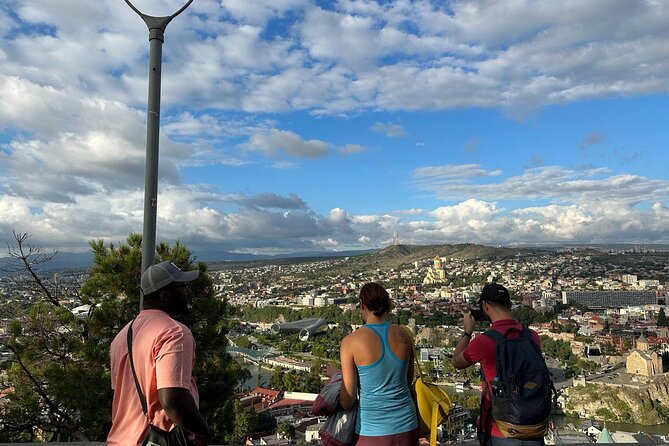
One of the most practical parts of this experience is the inclusion of the Rike-Narikala cable car. You’ll start from Rike Park, the center of Tbilisi, then take the cable car up toward the mountain area for breathtaking views. The cable car segment is listed as about 15 minutes.
Getting the viewpoint early is smart. It helps you later when you’re mapping how Old Town streets connect to the heights—why the walls, steps, and alleys feel the way they do.
After the cable car segment, you’ll meet Kartlis Deda—the Mother of Georgia monument. She’s positioned so she gazes down over the city, and the explanation connects her to Georgian women represented in bronze stone form. It’s another symbolic stop, but it’s also a view anchor.
This combo—cable car + viewpoint monument—is one reason this tour feels like more than “just walking.” It gives you the geography of Tbilisi in a single action.
Price and value: why $38 can work if you hate guesswork
At $38 per person for about 3 hours 15 minutes, this tour is priced for travelers who want structure without paying for a private guide. And the value isn’t only the time. The tour includes a professional guide service plus the cable car.
Many key stops have free admission, so your money goes into interpretation, not tickets at each door. That matters when you’re trying to control costs in a new city.
What’s not included is lunch. The plan is a stop at a traditional Georgian bakery where lunch can cost around 3–5 Gel (about 2–3 euros). That’s a helpful budget range because it’s modest. Still, you’ll want to arrive hungry or plan to add a snack if you skip the bakery option.
If you’re traveling in a group, there may be group discounts. And since there’s a mobile ticket, the experience is designed to be simple to use on the day.
Bottom line: if you’re the type who likes to understand what you’re looking at, this price tends to feel fair. If you only want photos and don’t care about explanations, you might feel it’s pricier than a self-guided walk.
Practical tips so you don’t trip over small rules
Keep these in mind and the tour stays smooth:
- Wear shoes you trust. Old Town streets can be uneven, and you’ll be moving for a few hours.
- For churches, plan for dress code expectations and remember no photos inside.
- If you care about the wine-tasting component, note the 18+ age rule.
- The tour can depend on good weather, so expect that rain can change plans.
- Group size stays small (up to 15), so you’ll likely walk at a human pace rather than a sprint.
Also, since the tour starts at Ioane Shavteli St and ends at Freedom Square, build your day around that flow. It’s easier to continue exploring afterward if you’re already oriented at the end point.
Should you book this Tbilisi Old Town walking tour?
I’d book it if:
- You want a guided way to connect Old Town sites instead of chasing them separately.
- You like culture through stories and symbols—Sioni, Tamada, Tree of Life, and the performance landmark all fit that style.
- You want the cable car viewpoint included without figuring out timing and tickets on your own.
- You prefer a small group where your questions get answered.
I’d think twice if:
- You dislike church rules like dress code and photo limits.
- You need long, slow museum-style time at each site.
- Your trip timing makes you nervous about weather-based changes.
If your goal is to get your bearings quickly and learn how the pieces of Tbilisi connect—faith, art, symbols, and modern direction—this tour is a strong choice.
FAQ
How long is the Tbilisi Old Town walking tour?
The tour runs for about 3 hours 15 minutes (approximately), and travel time is included in the duration.
What is the meeting point and where does the tour end?
The tour starts at 17 Ioane Shavteli St, T’bilisi, Georgia, and ends at Freedom Square in Tbilisi.
Is the tour offered in English?
Yes, it’s offered in English.
Is the cable car included in the price?
Yes, the experience includes the cable car.
What isn’t included, and how much should I budget for lunch?
Lunch isn’t included. The tour mentions a stop at a traditional Georgian bakery where lunch can cost around 3–5 Gel.
Do churches on the route have free admission?
The provided stop details list admission tickets as free for the churches and other main sights included in the walk.
Are there restrictions for visiting churches?
Yes. Taking pictures inside the church isn’t allowed, and the churches have a dress code.
Is there wine tasting on the tour, and what’s the age requirement?
The tour information lists a minimum age of 18 for wine tasting.
More Tbilisi Tours and Georgian Day Trips




More from Our Tbilisi Review Desk


More Old Tbilisi Walking Tours



Not quite your thing? More Tbilisi tours and day trips from our review desk










Old Tbilisi Walking Tours, compared.
 ★ 5.0Tbilisi Walking Tour Including Cable Car and Traditional BakeryFrom $191,310 reviews
 ★ 5.0Evening Walking & Talking Tour with Wine & Boat RideFrom $10572 reviews
 ★ 5.0Kakheti;City of Love Sighnaghi, Bodbe. KTW. Wine House Group tourFrom $16376 reviews
 ★ 5.0Old Tbilisi Highlights walking tour with wine & 10 tastingsFrom $15276 reviews
 ★ 5.0Old Tbilisi Tour: Private Walking Tour With Wine TastingFrom $39273 reviews
 ★ 5.0Private Tbilisi Food Tour: 9 Tastings Walk in Bohemian DistrictFrom $79227 reviews
 ★ 5.0Old and New City Guided Tour with 2 Cable Car RidesFrom $39176 reviews
 ★ 4.5City tour Tbilisi on red busFrom $20139 reviews
Browse the lists this tour appears in