
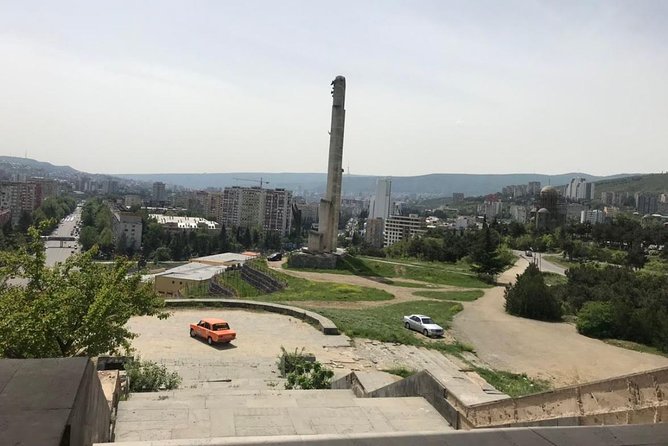
Reviewed · SOVIET & BRUTALIST TBILISI
Concrete Giants Tour
The Soviet years still shape Tbilisi. The Concrete Giants Tour takes you past monumental Communist-era architecture in a vintage Soviet car, then slows down at the unforgettable Chronicles of Georgia stop with a guide who connects buildings to real life.
I love that it stays focused and time-efficient—about 3 to 4 hours—and that lunch is included, so the tour doesn’t turn into a food scramble. I also like the small-group feel (max 20) and the fact it’s offered in English, with a professional guide you can actually talk to.
One thing to consider: this isn’t a neutral sightseeing circuit. Expect Georgia’s recent history and the tensions with its big northern neighbor to come up as part of understanding the architecture, especially the most political monuments.
In This Review
- Key things to know before you go
- Price and value: what $54.01 actually buys you
- Where the tour starts (Rose Revolution Square) and how the pace feels
- Rolling through Soviet-era Tbilisi in a vintage Soviet car
- Stop 1: Chronicles of Georgia (1975–1985) and why it matters
- Beyond monuments: Soviet residences, interiors, and design you can actually touch
- The guide’s angle: learning history through buildings, not just facts
- Lunch on tour: included food that keeps the day relaxed
- Logistics that affect your day (and how to plan around them)
- Who Concrete Giants fits best
- Should you book Concrete Giants Tour in Tbilisi?
- FAQ
- How long is the Concrete Giants Tour?
- What is the price per person?
- Is the tour offered in English?
- Where do I meet, and where does the tour end?
- Is lunch included?
- Is there a vegetarian option?
- Do I need admission tickets for Chronicles of Georgia?
- How big is the group?
- Cancellation policy
Key things to know before you go
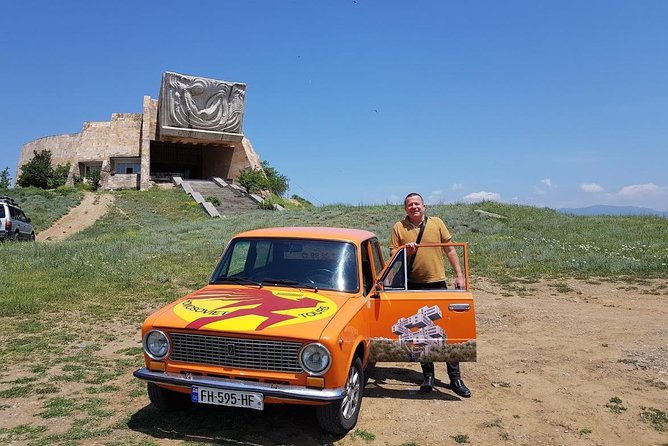
- Vintage car ride around Soviet-era Tbilisi for a faster, more story-driven route than walking alone
- A real guide (David) who ties design choices to daily life and politics
- Chronicles of Georgia stop with admission included, plus time to take it in
- Lunch and snacks included, so you’re fueled for interior stops
- Small group (up to 20) means more Q&A and less waiting around
Price and value: what $54.01 actually buys you
For $54.01, you’re not just paying for a drive and a couple photos. You’re paying for three practical things that add up fast in Tbilisi: transport in a private vehicle, a professional guide, and food during the tour (both lunch and snacks).
That food piece matters more than you might expect. In many cities, tours keep you moving and then leave you to find lunch yourself. Here, you can plan your day around one start time—11:00 am—and not worry about where you’ll sit and recharge halfway through.
You’re also getting admission included at the Chronicles of Georgia monument. That’s one less ticketing task and one less “surprise cost” late in the morning.
It’s also scheduled as a half-day format (3 to 4 hours), so it works well if you’re trying to fit history into a busy itinerary without turning your whole day into a museum marathon.
More Soviet and brutalist Tbilisi walks we have wandered off the tourist trail



Where the tour starts (Rose Revolution Square) and how the pace feels

Your meeting point is Rose Revolution Square, Tbilisi, and the tour ends back there. The start time is 11:00 am, and the schedule is designed so you can slot it into the middle of a day plan.
I like starting from a place that’s easy to orient from. Rose Revolution Square is big, recognizable, and simple to navigate toward by taxi or public transit. The tour is also noted as being near public transportation, so you’re not locked into hotel pickup.
The big “how it feels” factor is the transportation. You’ll be riding around in a private vehicle rather than long walks between sites. That’s a win in Tbilisi because distances can stretch—especially if you’re balancing stairs, hills, and stops that require a bit of patience.
Expect a guided flow: see exterior Soviet-era spaces, then get inside at least some buildings. That mix usually makes the architecture feel more human, not just monumental and distant.
Rolling through Soviet-era Tbilisi in a vintage Soviet car
The most memorable way to start a Soviet architecture tour is to travel in a Soviet-era vehicle. This tour uses a vintage Soviet car, and recent tour experiences describe it as classic—think the kind of vehicle that makes you look around before you even reach the first site.
You’ll feel the change immediately: you’re not just walking through “urban scenery.” You’re being transported as if the city has chapters, and the guide’s job is to connect what you see to what it was meant to do.
In places like Tbilisi, Soviet-era design can be easy to overlook if you just glance from street level. By riding slowly (and stopping), you get time to notice patterns: building proportions, public art placement, and how residences and civic spaces were planned to project authority and order.
Also, your guide’s storytelling tends to land better in motion. It’s easier to keep the timeline straight when you’re traveling site to site rather than pausing and starting over at each stop.
Stop 1: Chronicles of Georgia (1975–1985) and why it matters
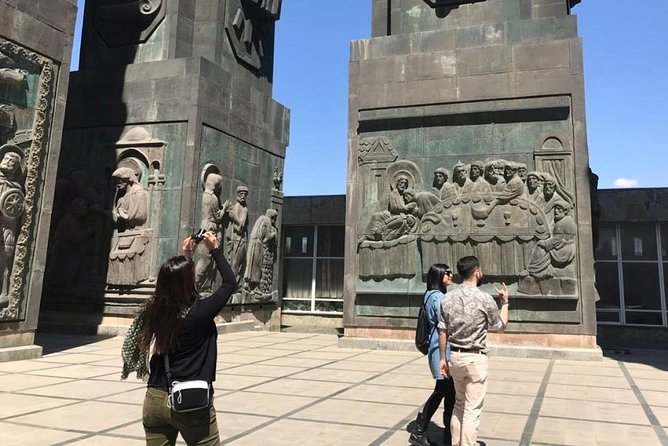
The anchor stop is the Chronicles of Georgia monument. It’s tied to the 1975–1985 era, and you’ll spend about 20 minutes there. Admission is included, so you can focus on the experience, not the logistics.
This is the kind of monument that teaches you how to “read” the city. It’s not only about what it looks like—it’s also about what it was meant to communicate at the time. Soviet-era civic design often worked like a public statement: large scale, strong symbolism, and a clear message.
Here’s what to do so it clicks fast:
- Look at the monument’s overall composition first, then come back for the details.
- Pay attention to where the monument puts people—how it frames the viewer and forces a viewpoint.
- When your guide explains the background, try to translate it into what you’d feel standing in front of it: pride, power, ideology, and identity all at once.
The payoff is that after Chronicles, the rest of the tour makes more sense. You start seeing how political messaging can show up as architecture, and how later generations live with those choices in the same streets.
Beyond monuments: Soviet residences, interiors, and design you can actually touch
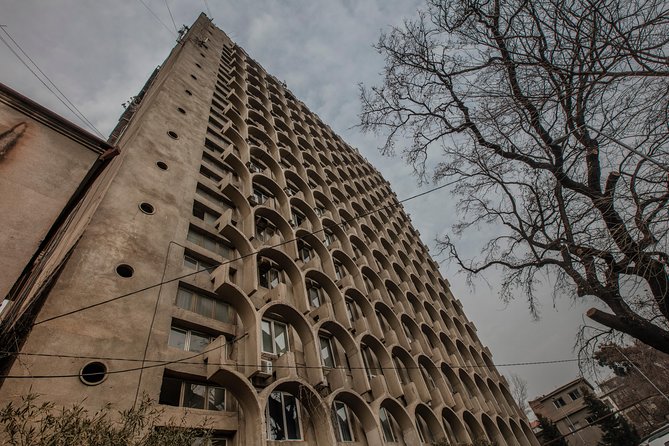
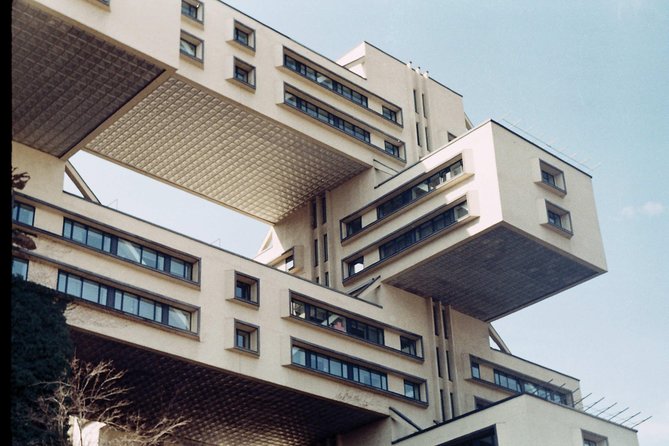
After Chronicles, the tour shifts from a single big icon to the “everyday architecture” side of Soviet influence. The experience typically includes Soviet monuments and residences, and you may also get a look at mosaics and other design elements that weren’t built for tourists.
One of the most praised parts of the tour is the chance to step inside a typical Soviet-era apartment block. That interior change is huge. Exteriors can feel abstract. Interiors show you the scale of living spaces, how buildings were organized, and what residents had to work with.
If you’re the type who likes architecture that has real consequences—layout, light, circulation, shared spaces—this part is where you’ll get your strongest emotional connection.
A practical note: interiors can involve stairs or areas with less “visitor-friendly” setup than a museum. The tour says most travelers can participate, but if you have mobility limits, it’s smart to consider that interiors may not feel fully accessible. (Ask your provider in advance if you want specifics.)





The guide’s angle: learning history through buildings, not just facts
A lot of tours list names and dates. This one tends to do something else: it connects the design to people and to politics.
The guide for these tours is often David, and the common thread in tour experiences is his ability to connect architecture to Georgia’s recent history in plain language. He’s described as a strong storyteller and someone who can handle questions patiently—useful if you want context that goes beyond a quick overview.
What you should watch for is how the tour frames the city’s “problematic relationship with its giant neighbor to the north.” Even if you don’t want politics, it helps to understand why certain monuments exist, why public art and civic planning look the way they do, and how ideology can be spread through design.
If you enjoy city thinking—urban planning, how governments shape daily life through housing and institutions—this tour is built for you. It also works well if you’re the curious type who asks questions like:
- What was the point of this building style?
- How do people live with these spaces today?
- Why do certain neighborhoods look the way they do?
Lunch on tour: included food that keeps the day relaxed

One of the standout details here is that lunch is included. You also get snacks, so you’re not hitting the wall between stops.
In many Soviet-era architecture tours, the route is long and the day gets tiring. Lunch as a planned part of the experience changes the rhythm. It gives you time to reset, ask more questions, and not worry about whether you’ll find something quickly nearby.
The lunch spot is described as a place that doesn’t see many tourists, which is exactly what I look for on a half-day tour: you get local food without turning it into a “food tour,” and you get to keep moving afterward without losing the thread.
Vegetarian travelers can request a vegetarian option when booking, which is a nice touch if you want to plan ahead instead of negotiating on the day.
Logistics that affect your day (and how to plan around them)
This experience is group-based with a maximum of 20 travelers, and it runs about 3 to 4 hours. That’s long enough for meaningful storytelling, but short enough that you can still add another stop later.
A few details to plan around:
- No hotel pickup: make your own way to Rose Revolution Square.
- The tour uses transport by private vehicle, so you won’t be doing all walking.
- It’s offered in English.
- Alcoholic drinks aren’t included, but they can be purchased, if that’s your thing.
- The experience ends back at the meeting point, so you don’t need to figure out a new endpoint.
There’s also a mobile ticket involved, and it’s confirmed within 48 hours subject to availability. If you’re traveling in a busy season, earlier booking can help lock in your slot—this one is commonly booked around a month in advance on average.
Who Concrete Giants fits best
This tour tends to click if you:
- Like Soviet-era architecture, public monuments, and the way politics shows up in the built environment
- Want a guided explanation in English that you can question as you go
- Prefer a small group over big bus tours
- Appreciate when history is paired with real living spaces (like apartment interiors)
It also works well if you’re a solo traveler who wants companionship without a heavy, all-day commitment.
If you only want postcard sights and zero political context, the story might feel too tied to Georgia’s recent history for your taste. But if you want the “why,” not just the “what,” it’s a strong choice.
Should you book Concrete Giants Tour in Tbilisi?
Yes—if you want Soviet-era Tbilisi explained through places you can see and sometimes step into. For the money, you get a real guide, a vintage car ride, Chronicles of Georgia with admission included, and a day-friendly format with lunch and snacks already handled.
Book it if:
- You’re excited by architecture with political context
- You’d rather ask questions than just listen to a script
- You want a focused 3–4 hour chunk that makes Tbilisi feel more layered
Skip it if:
- You dislike history talk that touches modern tensions
- You need fully accessible interiors (since the tour includes apartment-block experiences, you’ll want to ask first)
If you’re aiming for one standout history stop in Tbilisi that isn’t a typical museum beat, Concrete Giants is a practical, memorable way to see how ideology and everyday life were built into the city.
FAQ
How long is the Concrete Giants Tour?
It runs about 3 to 4 hours.
What is the price per person?
The price is $54.01 per person.
Is the tour offered in English?
Yes, the tour is offered in English.
Where do I meet, and where does the tour end?
You start at Rose Revolution Square, Tbilisi, Georgia, and the tour ends back at the same meeting point.
Is lunch included?
Yes. Lunch is included, and snacks are included as well.
Is there a vegetarian option?
Yes. A vegetarian option is available—you should advise at the time of booking if you need it.
Do I need admission tickets for Chronicles of Georgia?
No. Admission ticket for Chronicles of Georgia is included.
How big is the group?
The tour has a maximum of 20 travelers.
Cancellation policy
If you want a flexible plan: the tour offers free cancellation up to 24 hours in advance for a full refund.
More Tbilisi Tours and Georgian Day Trips




More from Our Tbilisi Review Desk
More Soviet and Brutalist Tbilisi Walks



Not quite your thing? More Tbilisi tours and day trips from our review desk












Soviet & Brutalist Tbilisi, compared.
 ★ 5.01 Day Private Armenia: UNESCO, Soviet & Curated Family LunchFrom $135106 reviews
 ★ 5.0Tbilisi old town & soviet heritage – Private driver-guided TourFrom $7783 reviews
 ★ 5.0Armenia: 1 Day Soviet gems, UNESCO + Family lunch (Small group)From $4968 reviews
 ★ 5.0Brutal Tbilisi: Urban exploration and untold storiesFrom $7559 reviews
 ★ 5.0Soviet Tbilisi Tour – Off the beaten pathFrom $4945 reviews
 ★ 5.0Soviet past – Private day tour to Chiatura, Katskhi pillar and ChroniclesFrom $14929 reviews
 ★ 4.5Soviet Story – Private day trip to Chiatura, Stalin’s museum and Katskhi pillarFrom $2015 reviews
 ★ 5.0Chiatura and Katskhi Pillar One Day Urbex TourFrom $12314 reviews
Browse the lists this tour appears in