
Reviewed · SOVIET & BRUTALIST TBILISI
Brutal Tbilisi: Urban exploration and untold stories
Concrete meets stories in Tbilisi. This 4-hour urban walk turns Soviet-era architecture into a lived-in story of Georgia’s past, present, and the people who still use these buildings every day.
What I like most is the small-group size (up to six), which keeps things moving and lets you ask real questions. I also love that multiple stops are admission-ticket free, so your money goes toward the guide and the route, not entry fees. One thing to consider: you should be ready for a moderate walking pace, and one stop is an abandoned museum space that can feel eerie.
In This Review
- Key points before you go
- Brutalist Tbilisi: how the architecture explains modern Georgia
- Price and what makes it worth about $75
- Meeting point and how the tour runs between stops
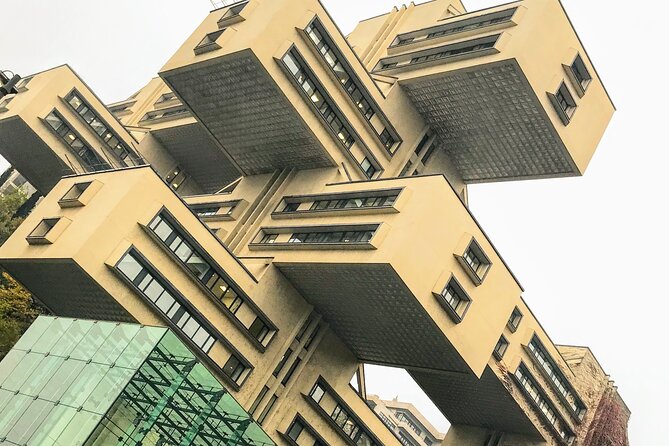
- Stop 1: Ministry of Highways of the Georgian SSR and the brutalist “power” feel
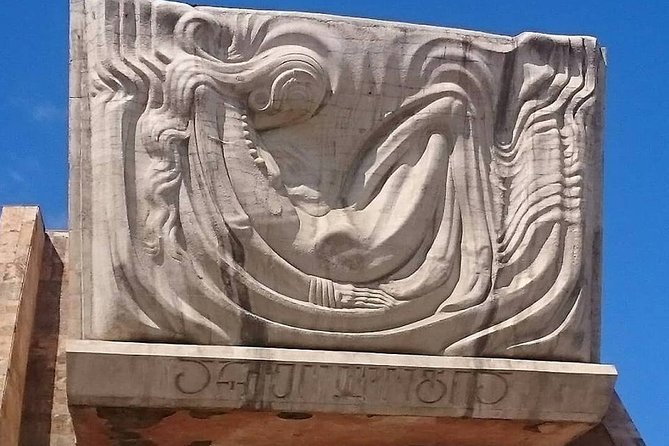
- Stop 2: Chronicles of Georgia monument, pillars of myth and statehood
- Stop 3: Former Archaeology Museum and why the abandoned feeling matters
- Stop 4: Maglivi Bridge area—refugee housing in old dorms and an old cable car
- Stop 5: Nutsubidze Skybridge—twin towers, 70 meters up, and the lift operator moment
- What to pay attention to during the tour (so it clicks)
- Who this tour is best for (and who might skip it)
- Should you book Brutal Tbilisi?
- FAQ
- How long is the Brutal Tbilisi tour?
- How much does the tour cost?
- Where does the tour start and end?
- Is hotel pickup included?
- Is the tour suitable for children?
- What is the cancellation policy?
Key points before you go
- Small-group format (max six): easier pacing and more time at each site for photos and questions.
- Free entry stops: several major monuments and buildings have free admission during the visit.
- Soviet to post-Soviet stories: you’ll connect the design style to how people lived under and after the USSR.
- Unusual interior access moments: highlights often include places where staff/operators are part of the experience, like at Skybridge.
- Guides bring the context: names like Alex, Khato, Aleksi, and Khatuna show up often for strong storytelling and clear explanations.
Brutalist Tbilisi: how the architecture explains modern Georgia
Brutalism in Tbilisi isn’t just an eye-candy style. It’s a clue. The heavy concrete, sharp geometry, and functional layouts were built for real needs—schools, ministries, student life, transport ideas—and those choices still shape how the city feels today.
This tour keeps your eyes at street level and mid-height. You’re not only looking at monuments from far away. You’re looking at how design affects movement, community, and daily routines—then you connect the dots to what changed after the Soviet era.
A big part of the appeal is the tone: it’s serious about design, but not stiff. The best guides on this route can sound like an encyclopedia on legs—full of stories, names, and reasons behind the concrete.
More Soviet and brutalist Tbilisi walks we have wandered off the tourist trail
Price and what makes it worth about $75
At $75 per person for around four hours, this works best when you care about architecture enough to go beyond the old-city postcards. The value comes from three things that add up fast:
- A local guide who explains what you’re seeing (not just where to stand for a photo).
- Bottled water included, which sounds small until you’re walking in Tbilisi heat or cool wind.
- Several stops with free admission, so the itinerary stays focused on the experience, not ticket add-ons.
It also helps that the overall cap is modest (the activity allows up to 14 people) and the actual walking group is kept tight (max six). That matters. With a big crowd, brutalist buildings often turn into a quick photo stop. Here, you’re more likely to get time to absorb details—concrete texture, proportions, and how people interact with the spaces now.
Meeting point and how the tour runs between stops
The tour starts at the Giant Bicycle monument by Rose Revolution Square. It ends back at the meeting point, so you don’t have to figure out a final transit puzzle at the end.
Hotel pickup is a different story. Pickup is only for private tours, while standard departures expect you to meet at the start point. The good news: the meeting area is near public transportation, so it’s not hard to reach even if you don’t want to taxi.
The pace is generally comfortable for most adults with moderate physical fitness. You’ll do plenty of walking and standing for photos, plus time in different spaces. If you’re sensitive to dim interiors, the abandoned-stop portion is the place to think ahead.
Stop 1: Ministry of Highways of the Georgian SSR and the brutalist “power” feel
This first stop is a strong introduction to Soviet-era brutalism in its most imposing form: the building of the Ministry of Highways of the Georgian SSR. It’s the kind of structure where the concrete looks heavy on purpose, like the building wants to command attention from every angle.
What makes it special is how the style plays both visually and functionally. You’ll notice massive concrete blocks and sharp lines that create a sense of stability. At the same time, the details aren’t random. They help the structure feel intentional instead of just cold.
Time here is about 30 minutes, and admission is free. Expect a focused explanation of the design choices and what the building represented in its era—then you’ll start seeing brutalism in Tbilisi as a language, not a trend.
Stop 2: Chronicles of Georgia monument, pillars of myth and statehood
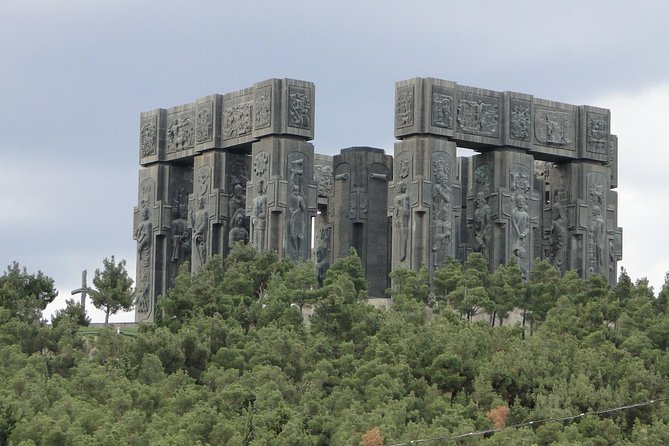
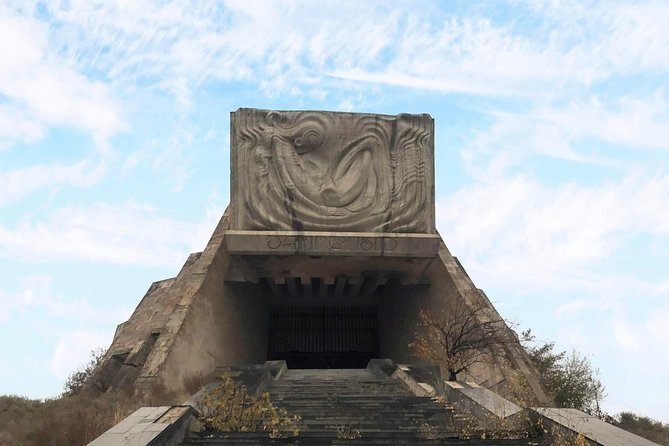
Next comes a monument that works like a stone timeline. The Chronicles of Georgia (the Memorial History of Georgia) sits up high with a commanding view over Tbilisi. You’re not just walking beside it—you’re positioned to read it.
The centerpiece is the set of massive stone pillars with scenes tied to Georgia’s identity: from the founding of the Georgian state to the country’s conversion to Christianity. The carving and relief work can be surprisingly detailed up close, especially if your guide slows down to point out what each pillar is showing.
Plan for about 45 minutes here, also free admission. The best moment is often when the guide connects the imagery to the bigger story Georgia tells about itself—how history, myth, and national identity get built into public space.



Stop 3: Former Archaeology Museum and why the abandoned feeling matters
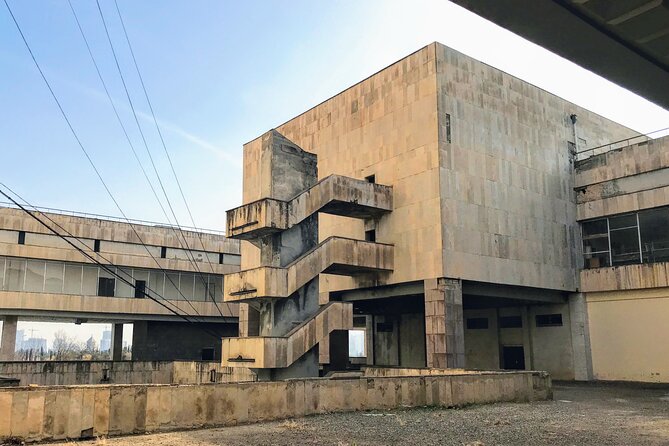
Then you hit the stop that changes the mood. The Former Archaeology Museum is now abandoned, and that’s part of why it hits. The “eerie” atmosphere isn’t a theme park effect—it’s real absence, and you can feel the building’s past importance in the way it holds space.
This is about more than exploring empty rooms. Your guide’s job is to help you read what you see: the architecture, the scale, and how museums (and the institutions behind them) reflect the priorities of the time when they were active.
You’ll get about 30 minutes at this stop, with free admission. If you’re prone to claustrophobia or you dislike dim, unfinished interiors, keep that in mind and wear appropriate footwear with good grip.
Stop 4: Maglivi Bridge area—refugee housing in old dorms and an old cable car
Stop four turns architectural analysis into a living reality lesson. In the Maglivi Bridge area, you’ll look at brutalist-influenced buildings that used to be tied to student life, but now serve as homes for refugees.
That shift matters. It changes what the concrete means. Instead of seeing the buildings as symbols of Soviet education and the ideal of progress, you see them as practical shelter now—architecture that has been repurposed by necessity.
You’ll also take in the old cable car in the university district, another piece of the city’s more modernist transport imagination. It’s the kind of structure that helps you understand how Tbilisi kept trying to modernize, even as politics and decades pulled the city in different directions.
This portion is about 30 minutes and marked as free admission. You’ll likely spend time photographing and listening. It’s also where a good guide’s tone helps—because the topic isn’t only visual. It’s human.
Stop 5: Nutsubidze Skybridge—twin towers, 70 meters up, and the lift operator moment
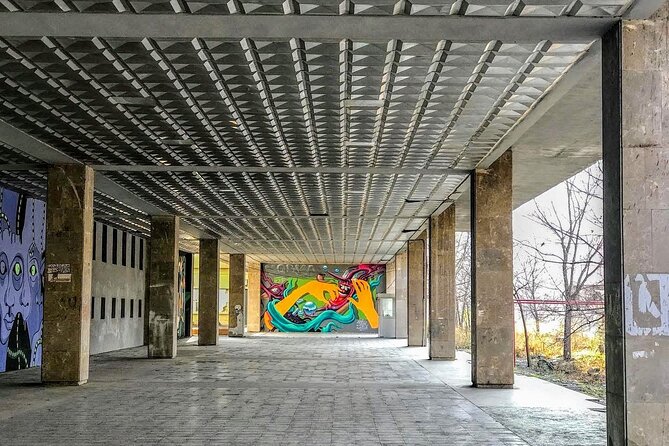
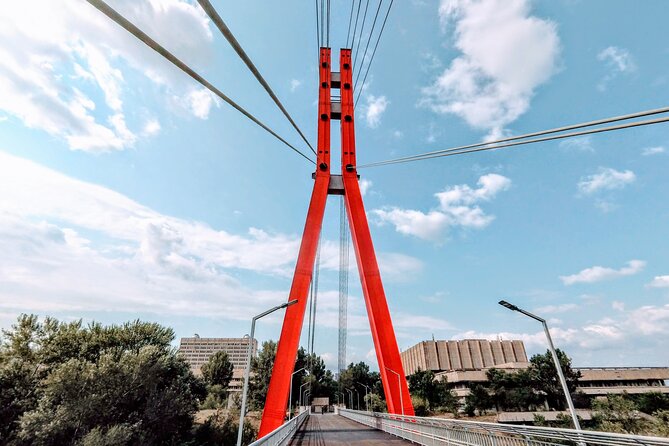
If you want the wow-factor finish, this is it. The Nutsubidze Skybridge features twin towers connected by walkways. The view starts working on you the minute you look down from the height: the bridges hang about 70 meters above the ground.
The key detail here is the connection design. These bridges aren’t just decorative—your position forces you to experience how the towers relate to each other and how you fit into the space. It’s also one of the easiest stops to get great city photos because you’re elevated and the geometry frames Tbilisi in a clean way.
Time is about 45 minutes, with free admission. And one of the standout moments that people often mention is getting to meet the lift operator lady at Skybridge. It’s not a scripted “performance”—it’s a real person connected to how this place functions, which makes the whole ending feel more grounded than a simple viewpoint.
What to pay attention to during the tour (so it clicks)
This tour works best if you go in with a couple of habits:
- Watch for how concrete shapes movement. Notice entrances, stairs, corridors, and where people naturally pause.
- Ask your guide to connect the style to who used the building when it was new. That’s where brutalism turns from a look into a story.
- Don’t rush photos. The guides are often happy to slow down so you can get both wide shots and close-ups of texture and detail.
Also, expect conversation. Guides such as Alex and Khato are often praised for linking architecture to the wider story of Georgia. If you’re even mildly curious about the Soviet and post-Soviet transition, this route gives you a framework that makes the rest of your trip click.
Who this tour is best for (and who might skip it)
This is a great fit if you:
- like Soviet and modernist architecture and want something more specific than the old town circuit
- enjoy walking but don’t want a marathon
- want context from a guide who can explain what you’re seeing in plain terms
It’s mainly aimed at adults. Kids can attend only if accompanied by an adult, but if you’re traveling with younger children, it’s wiser to choose a family-friendly option instead.
Skip or reconsider if:
- you hate abandoned spaces or don’t handle dim, unused interiors well
- you’re looking for purely scenic sightseeing with zero political or social context
Should you book Brutal Tbilisi?
Yes—if you want Tbilisi in a different key. This tour gives you a structured way to see brutalism up close and to understand what the buildings meant, not just what they look like. The small-group size, free admission at several stops, and the guide storytelling (often praised by name—Alex, Khato, Aleksi, Khatuna) are a strong mix for $75.
Book it when you have half a day to focus and when architecture is one of your travel interests. If you’re only in town for quick hits and you’re not curious about Soviet/post-Soviet design, you might find the angle too specialized. But for the right traveler, it’s one of the most memorable ways to see how Tbilisi thinks.
FAQ
How long is the Brutal Tbilisi tour?
The tour lasts about 4 hours.
How much does the tour cost?
It costs $75.00 per person.
Where does the tour start and end?
It starts at the Giant Bicycle monument near Rose Revolution Square and ends back at the same meeting point.
Is hotel pickup included?
Hotel pickup is available only for private tours. For regular bookings, you meet at the starting point.
Is the tour suitable for children?
The tour is designed primarily for adults. Children must be accompanied by an adult if they attend.
What is the cancellation policy?
You can cancel up to 24 hours before the experience for a full refund. If you cancel less than 24 hours before, the amount paid is not refunded.
More from Our Tbilisi Review Desk
More Soviet and Brutalist Tbilisi Walks
Not quite your thing? More Tbilisi tours and day trips from our review desk




Soviet & Brutalist Tbilisi, compared.
 ★ 5.01 Day Private Armenia: UNESCO, Soviet & Curated Family LunchFrom $135106 reviews
 ★ 5.0Tbilisi old town & soviet heritage – Private driver-guided TourFrom $7783 reviews
 ★ 5.0Armenia: 1 Day Soviet gems, UNESCO + Family lunch (Small group)From $4968 reviews
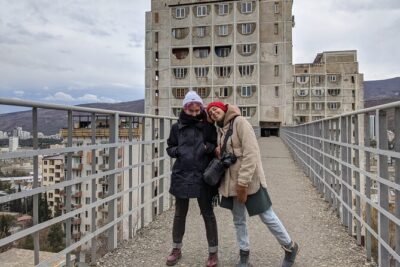 ★ 5.0Soviet Tbilisi Tour – Off the beaten pathFrom $4945 reviews
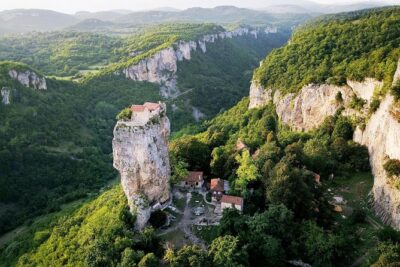 ★ 5.0Soviet past – Private day tour to Chiatura, Katskhi pillar and ChroniclesFrom $14929 reviews
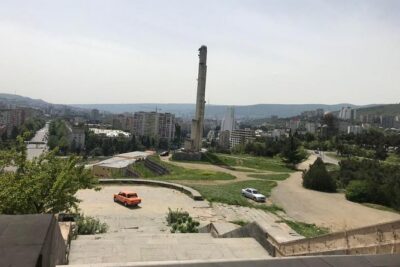 ★ 5.0Concrete Giants TourFrom $5420 reviews
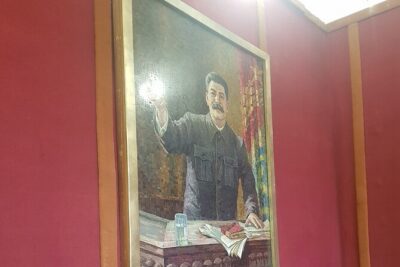 ★ 4.5Soviet Story – Private day trip to Chiatura, Stalin’s museum and Katskhi pillarFrom $2015 reviews
 ★ 5.0Chiatura and Katskhi Pillar One Day Urbex TourFrom $12314 reviews
Browse the lists this tour appears in