
Reviewed · MTSKHETA & JVARI UNESCO TRIPS
Private Walking Tour in Tbilisi and Mtskheta Old Town
Old Tbilisi feels like a living map. This private walk strings together the city’s most important sacred buildings and viewpoints, then sends you to Mtskheta for the big Georgia moment at Svetitskhoveli. You’ll start in the Old Town area near Liberty Square, cover major sites in Tbilisi on foot, then hop by private car to Mtskheta for a focused historical circuit.
I especially like two things: Giorgi’s ability to connect the dots between places and the political/religious story of the region, and the way the itinerary mixes must-see churches with smart “look back at the city” stops. The aerial tramway is a nice bonus too, since it’s included and gives you a quick, higher-angle view without turning the day into a hike. One possible drawback: the route leans heavily toward churches and hilltop viewpoints, so if you’re mainly after cafés or shopping, this might feel more “heritage tour” than “hangout day.”
In This Review
- Key highlights you’ll feel right away
- Why this Tbilisi-to-Mtskheta route fits 4 to 5 hours
- Meeting near Liberty Square, then getting a real jump on Old Town
- Stop 1: Anchiskhati Basilica and why “oldest” changes how you see everything
- Stop 2: Sioni Cathedral area, where faiths sit close together
- Stop 3: Jan Shardeni Street (Jean-Baptiste Chardin) for the Old/New mix
- Stop 4: Metekhi Cathedral by the Mtkvari, plus King Vakhtang Gorgasali
- Stop 5: Tbilisi Cable Car for quick, easy city views
- Stop 6: Narikala Fortress, where the city spread makes sense
- Stop 7: Jvari Church and the river meet view over Mtskheta
- Stop 8: Svetitskhoveli Cathedral in Mtskheta and the hills of Jvari Monastery
- Price and value: $55 for guided history plus a paid-included tram ride
- Who this tour is best for (and who should skip it)
- Should you book this Tbilisi and Mtskheta private walking tour?
- FAQ
- How long is the private walking tour?
- What does the tour cost?
- Is pickup included, and where does the tour start?
- Is the tour private or shared?
- What language is the tour offered in?
- Is the aerial tramway ticket included?
- Are admissions included for the stops?
- How does the Mtskheta part of the tour work?
- How will I receive my ticket information?
- What is the cancellation policy?
Key highlights you’ll feel right away
- Oldest to iconic churches in one loop, including Anchiskhati Basilica and Sioni Cathedral area
- Sioni Cathedral area as a real neighborhood of faiths, with multiple nearby religious sites visited in sequence
- Jan Shardeni Street (Jean-Baptiste Chardin) for how Tbilisi blends old rhythms with newer life
- Aerial Tramway ticket included, so you get views without extra cost or planning
- Narikala and Jvari viewpoints, timed to give you big-bird views over the Mtkvari and the river meet
- Private group format, so the guide can pace the walk for your questions and interests
Why this Tbilisi-to-Mtskheta route fits 4 to 5 hours
This tour is built for people who want the big hits without the guesswork. In about 4 to 5 hours, you cover major religious landmarks in Tbilisi’s Old Town, ride the Tbilisi cable car, then make it to Mtskheta by private car (about 30 minutes) for the key sites there. You don’t have to assemble a mini itinerary from scratch, and you’re not stuck waiting around for a group that moves at its own pace.
I also like the structure. You get a clear sequence: start with foundational Tbilisi (oldest buildings), move through the historic streets and river area, then finish with the high viewpoints and the Mtskheta “capstone.” That flow matters because Tbilisi and Mtskheta are easier to understand when you see the geography and power centers in the right order.
One small planning note: it’s private, so you’ll still be doing real walking between stops. You’ll probably want comfortable shoes, especially for viewpoints like Narikala and Jvari where the ground may be uneven.
More Mtskheta and Jvari UNESCO runs we have made from Tbilisi
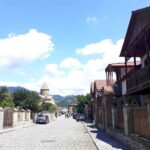
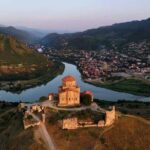
Meeting near Liberty Square, then getting a real jump on Old Town
Your tour starts around Liberty Square, and the early part of the day is all about orientation. From that pickup zone, you walk through the densest historic pocket of Tbilisi, hitting important sites close together so the day feels efficient.
Then, after the Old Town portion, the tour shifts into a different mode: a whole group goes to Mtskheta by private car. That part is a big value add. Instead of you figuring out transportation while also trying to see the sites, the driver simply gets you there, and the guide keeps the story going.
By the end, you return back to Tbilisi by car. That round-trip structure is ideal if you want a day that stays manageable. It’s also helpful if you’re tired of long transit legs between attractions.
Stop 1: Anchiskhati Basilica and why “oldest” changes how you see everything
You start at Anchiskhati Basilica, described as the oldest building in Tbilisi. The time budget here is short (about 10 minutes), which is exactly right for a first hit. You’re not getting stuck in one spot. You’re establishing the baseline, then moving on to the next layer of the city.
Even in a short visit, being in a place like this shifts your perspective. Tbilisi’s story isn’t only about what’s pretty or what’s famous today. It’s also about how old ideas and institutions kept shaping the city long after new buildings rose around them. Anchiskhati gives you that anchor.
Because admission is free, you’re also not pressured to “get your money’s worth” in the usual way. You can focus on the atmosphere and the meaning instead of keeping one eye on ticket counters.
Stop 2: Sioni Cathedral area, where faiths sit close together
Next comes Sioni Cathedral Church, one of the oldest sites in Tbilisi, with a really distinctive neighborhood feel. This stop is about 15 minutes, and it’s not just one building. The tour includes visiting the surrounding religious sites nearby, including a Muslim mosque, an Armenian church, a Jewish Synagogue, and a Catholic church.
For me, that’s one of the most interesting parts of the whole tour because it turns geography into context. Instead of learning religion as theory, you see it as lived space—different communities in close proximity, shaping daily life and local identity.
One practical upside: because these sites are grouped, you can understand the area as a walkable micro-world. The guide’s job here is key, since the meaning is layered and it helps a lot to have someone explain what you’re looking at while you’re looking at it.
Stop 3: Jan Shardeni Street (Jean-Baptiste Chardin) for the Old/New mix
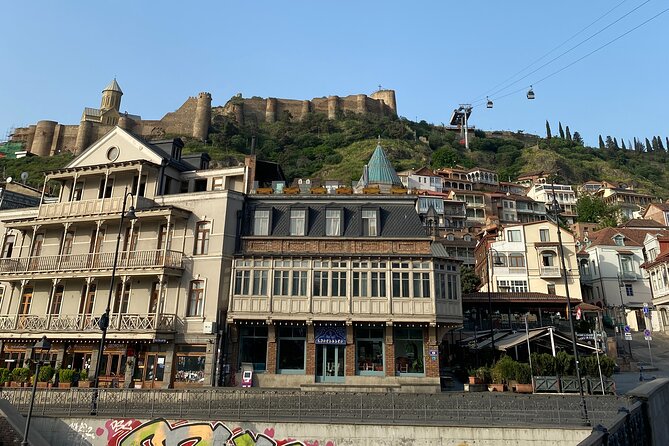
From the cathedral cluster, you move onto Jan Shardeni Street, also tied to the name Jean-Baptiste Chardin. You’ll spend about 15 minutes here.
This stop is your “human scale” break. Churches and fortresses tell you how power worked. A street like this tells you how people live around that history. The point is the blend: old-style city life alongside newer patterns. It’s the kind of place where you start noticing details you’d otherwise miss, like how neighborhoods keep their character even as businesses and routines change.
Admission is free at this stop, so it’s a low-stress way to break up the heavier historical sites. It also helps you reset before the river and the viewpoints.
More Old Tbilisi walking tours through the balconied backstreets


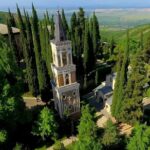



Stop 4: Metekhi Cathedral by the Mtkvari, plus King Vakhtang Gorgasali
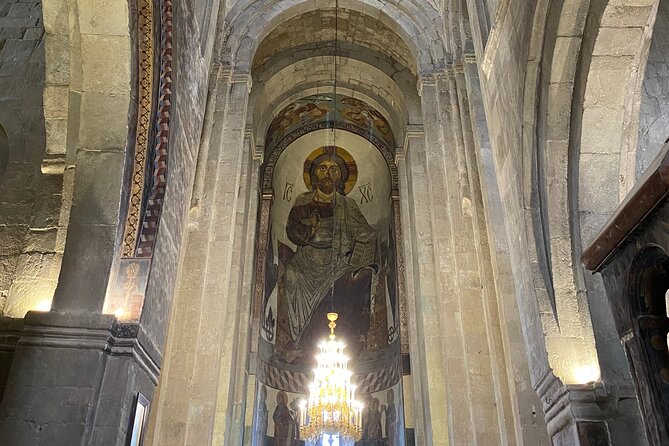
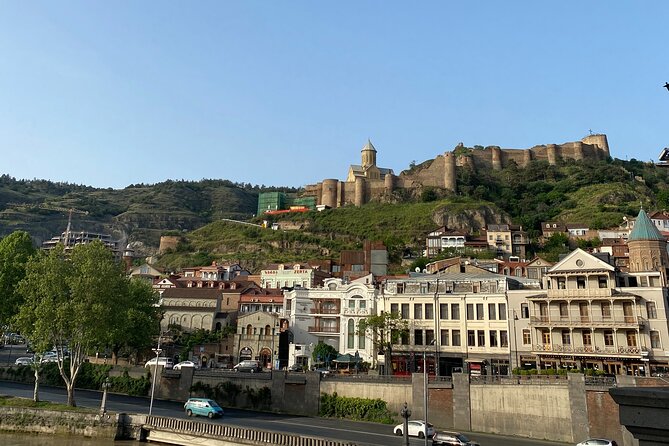
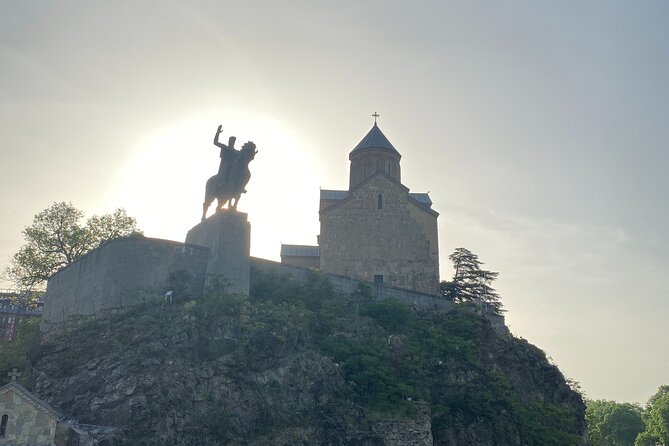
Metekhi Cathedral sits on the left bank of the river Mtkvari. The stop is about 15 minutes, and the tour pays attention to the yard decoration: a statue of King Vakhtang Gorgasali, a 5th-century ruler credited with building a strong castle and the very first church there.
That connection to Vakhtang matters. The tour repeats his influence again later at Narikala, which makes the day feel like one story rather than scattered stops. Once you know he’s linked to multiple points, you start spotting the same historical logic in different places: control the height, control the river, anchor the religious center.
This is also where you get a better sense of how the river shapes Tbilisi’s layout. The Mtkvari isn’t just scenery. It’s a geography lesson, and your guide will help you “read” it as you move.
Stop 5: Tbilisi Cable Car for quick, easy city views
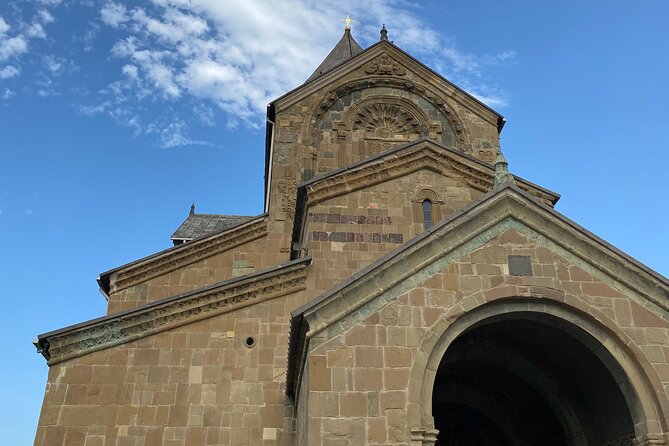
Then you get to a break that’s pure reward: the aerial tramway. This stop runs about 15 minutes, and the cable car ticket is included.
If you’ve ever wasted time trying to find the best viewpoint on your own, you’ll appreciate why this helps. From the air, the Old Town reads differently. You see the density, the slopes, and the way the city funnels toward its key historic points.
It’s also a smart value move. Since most other entries on the route are free, your money is going into guiding and the private movement between sites—while the tram gives you a memorable viewpoint without extra ticket hassle.
Stop 6: Narikala Fortress, where the city spread makes sense
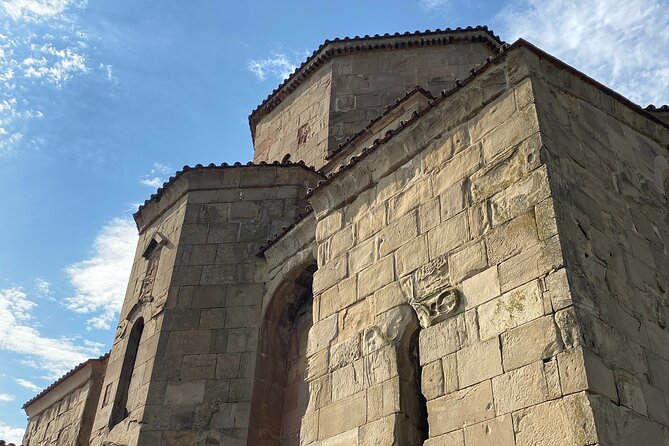
From the tram side, you reach Narikala Fortress, spending about 40 minutes. This is one of those stops where the time matters because it’s not only about looking. It’s about letting the view teach you the city’s shape.
Narikala overlooks Tbilisi and the Mtkvari River. The first walls were also built by Vakhtang Gorgasali in the 5th century, which ties the whole Vakhtang thread together again. It’s a good moment to look back at what you saw earlier at Metekhi and understand why these locations were chosen.
Admission here is listed as free, so the main “cost” is your time and attention. I’d treat this as your chance to slow down a bit. If you ask a couple questions now—about how power worked, or how the old city formed—you’ll likely get answers that make the rest of the day click.
Stop 7: Jvari Church and the river meet view over Mtskheta
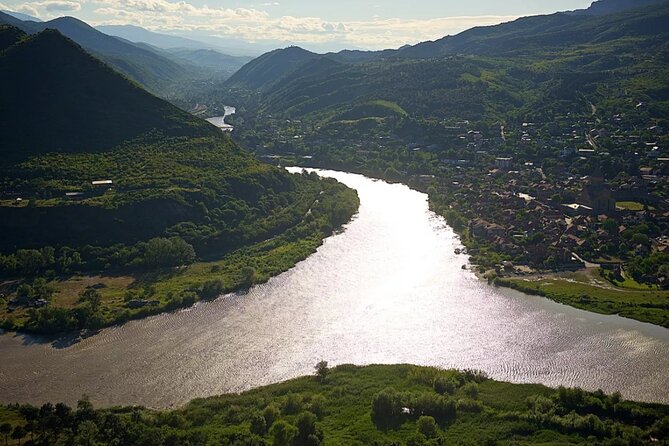
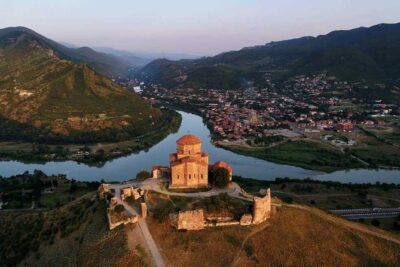
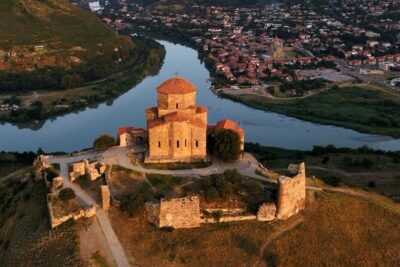
Next is Jvari Church, with about 1 hour here. The site is known for a 14th-century-old building and ancient castle walls. The big draw is the viewpoint: the meeting of rivers, Mtkvari and Aragvi, plus a view over Mtskheta from above.
This is where the tour shifts from Tbilisi’s city story to Mtskheta’s role as a major historic center. You’ll feel the contrast right away: Tbilisi is clustered and layered. Jvari gives you the wider geography, and that wider view helps you understand why Mtskheta mattered.
Since the stop includes the viewpoint component, plan for a calm pace. Let your eyes do some work. Your guide’s explanations will sound even better once you can actually see what they’re talking about—two rivers meeting, a city laid out below, and the strategic advantage of the hill.
Stop 8: Svetitskhoveli Cathedral in Mtskheta and the hills of Jvari Monastery
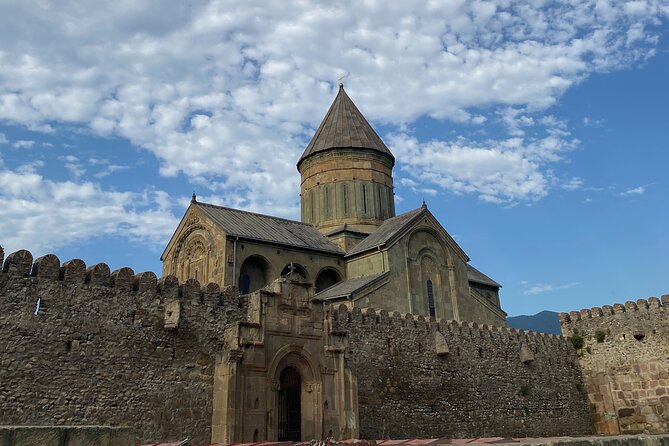
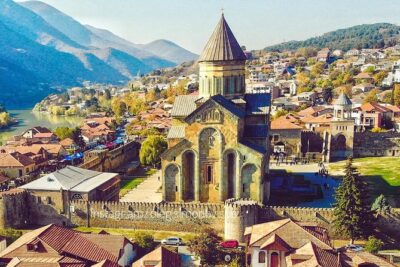
The tour’s Mtskheta segment includes visiting Svetitskhoveli Cathedral and spending time on the surrounding sightseeing. The route description emphasizes that Mtskheta is the most ancient capital of Georgia, and the tour frames the cathedral as part of that larger story.
You’ll also get sightseeing from the hills of Jvari Monastery, which pairs nicely with the earlier Jvari Church viewpoint. Together, they give you both the story from above and the more grounded sense of where religious life played out in the city.
Admission for this portion is also free in the tour listing, which makes it easier to stay focused on meaning instead of costs. And because you’re wrapping the tour here, you end on a “big picture” note—exactly what you want at the end of a concentrated day.
Price and value: $55 for guided history plus a paid-included tram ride
At $55 per person for 4 to 5 hours, this tour sits in the sweet spot for a private format. The big value ingredients are:
- Most admissions listed as free across the stops
- Cable car ticket included, so you get a paid activity without paying extra
- Private-guided experience in English through multiple major sites
- Private car transfer to Mtskheta (about 30 minutes each way as described), which saves you effort and uncertainty
If you break it down, you’re paying mainly for the guide’s time, the pacing, and the “how to understand what you’re seeing” part. When you want history and politics explained in a practical way—without turning it into a lecture—this kind of guided structure is worth it.
The tour also uses a mobile ticket, and you get confirmation at booking. That’s the boring stuff that still matters, because it reduces friction when you’re trying to enjoy the day.
Who this tour is best for (and who should skip it)
This is a strong match for you if:
- You want an Old Town + viewpoint day without planning every step
- You’re interested in how religion and local politics connect to real places
- You like guided explanation that makes the city feel understandable
- You want a day trip to Mtskheta without dealing with transit logistics
I’d think twice if:
- You’re mostly after modern nightlife, long café breaks, or shopping streets
- You hate walking between sites and viewpoints in a tight time window
- You prefer to move independently with no schedule at all
Since it’s a private tour/activity, it’s also a nice option for couples or small groups who want the guide to respond to your questions. Service animals are allowed, and the tour is offered in English, with pickup near public transportation.
Should you book this Tbilisi and Mtskheta private walking tour?
Yes, if you want a high-meaning day that still stays efficient. The itinerary covers the city’s roots in Tbilisi, the faiths you can actually see side by side in the Sioni area, then it scales up to Mtskheta with the kind of views that explain why these places mattered.
If you book, go in with one mindset: let the guide connect sites to story. That’s where the experience shines. Ask about the role of King Vakhtang Gorgasali when you reach Metekhi and Narikala. Ask how the river geography supports the viewpoint logic at Jvari. Do that, and you’ll leave with more than photos.
FAQ
How long is the private walking tour?
It runs about 4 to 5 hours.
What does the tour cost?
The price is $55.00 per person.
Is pickup included, and where does the tour start?
Pickup is offered, and the tour starts around Liberty Square.
Is the tour private or shared?
This is a private tour/activity, so only your group participates.
What language is the tour offered in?
The tour is offered in English.
Is the aerial tramway ticket included?
Yes. The aerial tramway (cable car) ticket is included.
Are admissions included for the stops?
The tour listing shows free admission tickets for the stops in the itinerary, except the cable car which is included.
How does the Mtskheta part of the tour work?
After the Tbilisi walking portion, the group goes to Mtskheta by private car (about 30 minutes). You then continue visiting historical places and return to Tbilisi by car.
How will I receive my ticket information?
You’ll receive a mobile ticket.
What is the cancellation policy?
You can cancel for a full refund up to 24 hours in advance. Changes within 24 hours of the start time aren’t accepted.
More from Our Tbilisi Review Desk



More Old Tbilisi Walking Tours
More Mtskheta and Jvari UNESCO Runs


Not quite your thing? More Tbilisi tours and day trips from our review desk









Mtskheta & Jvari UNESCO Trips, compared.
 ★ 5.0Day Trip to Mtskheta Gori and UplistsikheFrom $291,801 reviews
 ★ 5.0Mtskheta,Jvari,Bazaar,wine tasting,Chronicles of GeorgiaFrom $20730 reviews
 ★ 5.0Mtskheta-Gori-UplistsikheFrom $90112 reviews
 ★ 4.5Mtskheta, Jvari, gori, uflistsikhe, history and panorama (group tours)From $19107 reviews
 ★ 5.0Mtskheta-Jvari-Uplistsike-Chronicle of Georgia, PRIVATE TripFrom $68105 reviews
 ★ 4.5Tbilisi – Mtskheta – Jvari. Full City Tour on Hop On Hop Off BusFrom $4091 reviews
 ★ 4.5Ancient Georgia Group Tour: Mtskheta,Jvari, Gori, UplistsikheFrom $2473 reviews
 ★ 5.0Ancient Mtskheta and Chronicle of Georgia half day tourFrom $6566 reviews
Browse the lists this tour appears in