
Reviewed · OLD TBILISI WALKING TOURS
Tbilisi by Night Walking Tour
Tbilisi glows after dark. I like how this tour pairs a local guide’s stories with a real walk through Old Town at night, not just photo stops. I also love the built-in hilltop payoff, with views from Mtatsminda after you’ve already seen the lights downtown. One drawback: you cover ground on uneven streets and slopes, so comfortable shoes matter.
This is a small group format (max 15), and the pace is set for questions. The guides I heard named in the experience—Anya and Zora—come across as patient and willing to answer detail-level curiosity, from puppet-theater lore to practical advice on where to eat and drink.
In This Review
- Key highlights you’ll actually feel on this tour
- Why this night walk is such a great first evening in Tbilisi
- Price and what you get for $72.25
- Timing, pace, and the logistics you should plan for
- Entering the Old Town glow: Berikaoba, the puppet theater, and the angel bell
- Anchiskhati Basilica and the Baratashvili Bridge photo viewpoint
- LED lights over the Kura: Bridge of Peace and Narikala Fortress
- Cable car to the hilltop: Rike-Narikala and the National Botanical Garden context
- Leghvtakhevi waterfall at night, then Chreli Abano’s secret viewpoint
- Liberty Square, the funicular stop, and Mtatsminda Park’s final night payoff
- Photo strategy that won’t slow you down
- Who should book this tour, and who might skip it
- Should you book this Tbilisi by Night Walking Tour?
- FAQ
- How long is the Tbilisi by Night Walking Tour?
- What time does the tour start?
- How much does the tour cost, and what’s included?
- Is the Tbilisi funicular included?
- Do I need to pay admission at the stops?
- Where do I meet the guide, and where does the tour end?
- What’s the cancellation policy?
Key highlights you’ll actually feel on this tour
- Old Town landmarks with night lighting: Basilica pass-by, LED bridge walks, and fortress light shows
- The Rezo Gabriadze clock tower angle: an angel-and-bell story tied to the marionette theater area
- Hill views built into the route: cable car to the top, then Mtatsminda Park observation decks
- Free entry sights that stay interesting: multiple stops are free to enter, so your money goes to the guide and transport
- Photo “set pieces”: viewpoints at Baratashvili Bridge, Chreli Abano, and the cable car/observation deck stages
Why this night walk is such a great first evening in Tbilisi
If it’s your first time in Tbilisi, night is a smart way to learn the city. Daytime gives you buildings. Night gives you atmosphere, light, and quick context for where everything sits. This tour uses that idea well: you start in the Old Town orbit, then move outward and upward until the city looks like it’s layered in lights.
What makes it feel practical is that it’s not only sightseeing. The guide also adds local cultural context—how folk traditions show up in places you’re walking past, why certain towers and churches matter, and what neighborhoods you’re actually moving through. By the time you reach the high viewpoint sections, the sights stop feeling random. You start connecting them.
I also like that the route keeps changing the view. You’re not stuck staring at one street corner for 3 hours. You’ll cross bridges over the Kura River, pause at fortress lighting on Metekhi hill, then shift to cable-car and observation-deck angles. It’s a “city model” made for feet.
More Old Tbilisi walking tours through the balconied backstreets
Price and what you get for $72.25
At $72.25 per person, this isn’t the cheapest option on a map of Tbilisi tours. But the value is solid because two things are handled for you:
- You get a guided route for about 3–3.5 hours, starting at 7:00 pm.
- The cable car is included (one way), which matters because several of the best viewpoints are not in easy walking distance.
Most other stops on the night plan are listed as free entry. That means your money mostly pays for the guide, time, and the transportation piece that helps you reach the hilltop views without turning the evening into a steep endurance test.
Also, the max group size of 15 is a real part of the value. It’s small enough for conversation. You can ask why a church is important, or what a clock tower story has to do with the surrounding area, without feeling like you’re shouting at a bus.
Timing, pace, and the logistics you should plan for
This experience runs from 7:00 pm and typically lasts 3 to 3.5 hours. The route mixes short photo stops with longer stretches of walking, including segments that take around 10–20 minutes at a time, plus one longer “get there and look around” moment after the cable car ride.
Here’s the practical takeaway: plan to move. You’ll be on cobblestones or uneven surfaces in parts of Old Town, and the city’s hills show up fast on a night walk. The tour description and guest feedback both point to comfort shoes as a must—especially because you’re doing it after dark.
Another practical note: the tour begins at Berikaoba and ends near the Lower Station of the Tbilisi Funicular. That matters because your night doesn’t end on a dead stop; it ends at a place where you can keep exploring, including the option to use the funicular later.
Finally, guides may be multi-lingual, and the tour is offered in English. Service animals are allowed, and it’s near public transportation. If you’re joining solo, the small group size can make it feel more personal rather than chaotic.
Entering the Old Town glow: Berikaoba, the puppet theater, and the angel bell
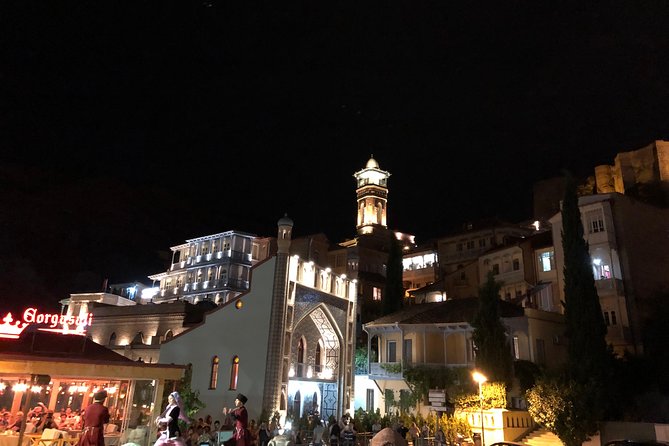
Your night starts next to Sculpture Group Berikaoba. This is a good opening because it’s not just “look at the statue.” Your guide sets the tone with a story about improvised masqueraded folk theater in Georgia—rooted in pagan ideas tied to fertility and rebirth. Even if you’re not a folklore fanatic, it gives you a lens for the Old Town. You start noticing that entertainment, ritual, and public life have historically been mixed in Georgia.
From there you head toward Rezo Gabriadze Marionette Theater and the clock tower next to it. In Tbilisi Old Town, timepieces aren’t only decoration. The clock tower has a tradition in which an angel appears every hour to ring the bell. It’s the kind of detail you’ll feel silly not knowing once you see it—then you’ll be grateful you do.
There’s also a specific night-theater moment to watch for: a small show called The Circle of Life at the puppet theater and clock tower around 7:00 pm. Even if you’re joining right at the start, this is exactly the kind of stop that turns the tour from sightseeing into cultural experience.
After that, the evening shifts into walking mode. You’ll move about 20 minutes between stops, so this is where comfort shoes pay off again.
Anchiskhati Basilica and the Baratashvili Bridge photo viewpoint
As you continue, you’ll pass Anchiskhati Basilica of St Mary. This is the oldest surviving church in Tbilisi and dates from the sixth century. Passing it on a night walk is powerful because you get the contrast: ancient stone near modern night lighting and a living street scene. Your guide’s context helps you read what you’re looking at instead of treating it like a quick background texture.
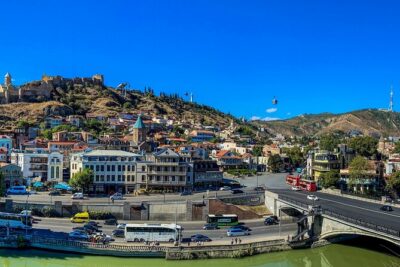
Then you hit Baratashvili Bridge. The bridge has its own history—built in 1966 in place of the dismantled Mukhrani Bridge, honoring Princess Mukhrani. More than the story, though, it’s a practical viewpoint stop. You’ll pause at an overlook to take photos of Old Town. If you like crisp night photos, this is one of your key “hold still and frame carefully” moments.
One mild drawback of bridge viewpoints is crowding, especially near iconic photo angles. The fix is simple: keep your camera ready, but don’t stand planted the entire time. Take your shot, then let the group flow to the next location.


LED lights over the Kura: Bridge of Peace and Narikala Fortress
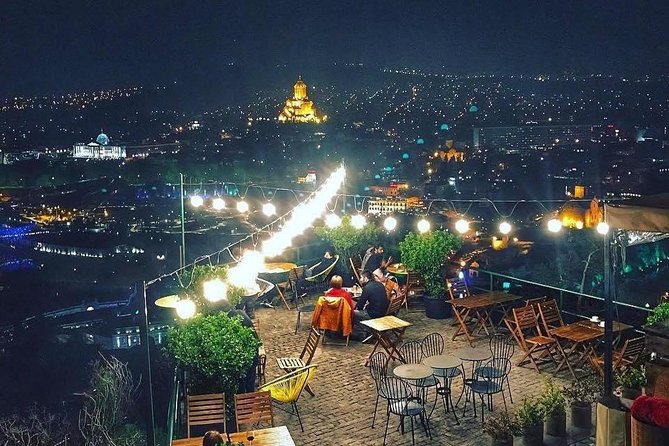
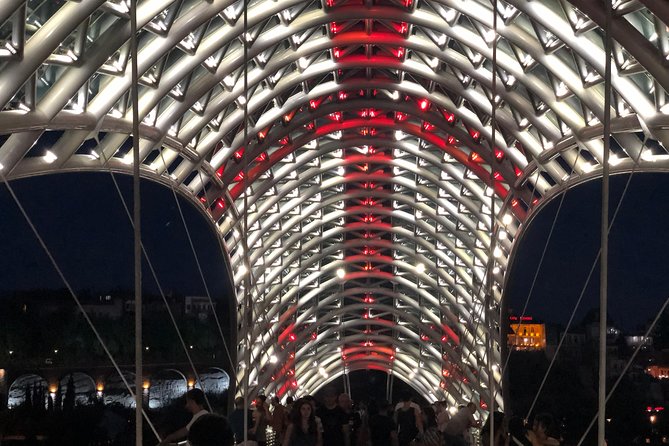
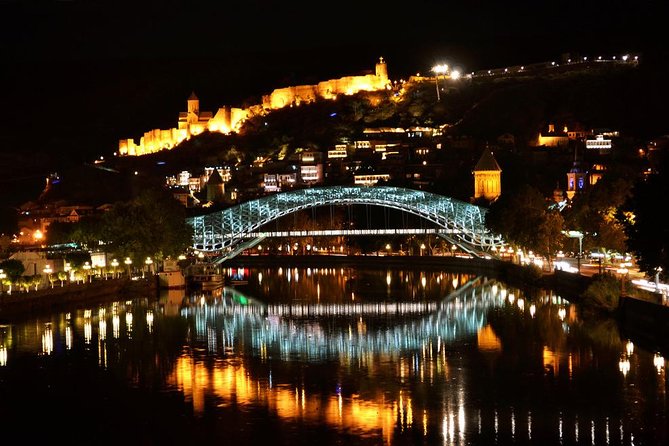
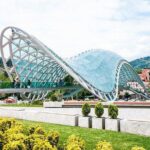
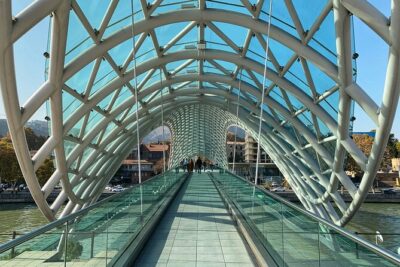
Next up is the Bridge of Peace, a steel-and-glass structure lit up with numerous LEDs over the Kura River. At night, it almost behaves like a moving skyline rather than just a crossing. Walking it is usually a highlight because the lighting gives you a dynamic feeling—you’re moving through the city’s reflections while the Old Town tones sit in the background.
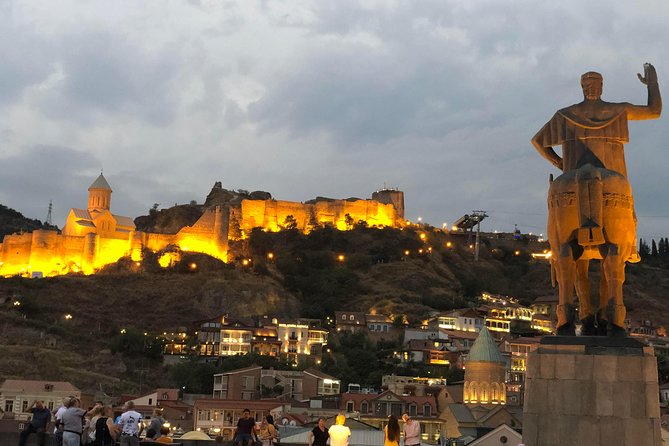
After the bridge, you head toward Narikala Fortress on Metekhi hill. This stop is all about the fortress light show. Your guide ties in the fortress’s historical significance and architecture while you watch how the illumination changes the silhouette.
This is also a good moment to ask questions, because it’s the kind of site that invites interpretation. A fortress isn’t only “ancient walls.” It’s a reason for the city’s layout and a reason for why viewpoints exist where they do.
If you don’t love looking at heights, you might find this part more about listening than staring. The upside: your guide can keep the focus on meaning while you take in the light show at a relaxed pace.
Cable car to the hilltop: Rike-Narikala and the National Botanical Garden context
From Narikala area you reach Rike-Narikala Cable Car (Lower Station). The cable car ride is included one way, and it’s a smart piece of logistics. It lifts you to the hilltop without spending the evening fighting steep stairs or taking a taxi between viewpoints.
Once you’re up, there’s time to take in views of the Old Town. The tour description also notes guide information about the National Botanical Garden of Georgia, located in the Tsavkisis-Tskali Gorge on the southern foothills of the Sololaki Range. Even if you’re not heading there tomorrow, it helps you understand the geography behind the city’s edges and viewpoints.
You’ll also pass by Jumah Mosque, described as lightened up, where Sunni and Shia Muslims pray side by side. That detail matters because it changes how you “read” religious architecture at night. Instead of treating it as scenery, you understand that it’s part of living community life.
Leghvtakhevi waterfall at night, then Chreli Abano’s secret viewpoint
The next big shift is toward Leghvtakhevi Waterfall, described as in the very center of Tbilisi. At evening time, it’s impressive with a lights show. The timing is short here—about 10 minutes—but it’s long enough to feel the effect if you go with your eyes open. It’s the kind of place where the city seems to fold nature into daily life.
Then you head to Chreli Abano. This is a viewpoint stop with a specific photo concept: you can frame shots so your pictures can be put in one screen with Tbilisi houses with balconies, a mosque, a church, fortress elements, and sulfur baths. Even if you don’t do the screen-composite thing, the location is clearly chosen for giving you a “whole city” perspective in one glance.
After that, you’ll spend some time around Abanotubani (the sulfur bath area), with time to enjoy views of tiny streets and take photos. This is where Old Town energy turns from major landmarks into human-scale lanes. It’s also one of the best areas to slow down mentally, because the night street lighting makes the alleys feel intimate even when you’re surrounded by other people.
Liberty Square, the funicular stop, and Mtatsminda Park’s final night payoff
Next comes Liberty Square, with views of the Monument of St. George lit at night. It’s a quick stop, but it’s useful. It gives your route a “city center anchor” feeling after all the hills and historic layers.
Then you reach Tbilisi Funicular (Lower Station). This part is more about impressions and storytelling than riding. You’ll have a short time to shoot a video while your guide explains the history of the place. The funicular round-trip is not included, so think of this moment as your chance to capture what you see and decide if you want to continue on afterward using your own ticket.
Finally, the evening climbs again—Mtatsminda Park and the observation deck. This is the grand finale. You get views of the glowing modern and old buildings of Tbilisi in one direction, and the night turns into a map you can actually understand. If you like nights where the last stop changes your mood (instead of ending on the same view you had earlier), this one typically does.
Photo strategy that won’t slow you down
If you’re bringing a phone or camera, you’ll be happiest if you go for “target shots” rather than trying to photograph everything.
- Use Baratashvili Bridge as your broad Old Town photo angle.
- Treat Bridge of Peace as your reflections and light trail moment.
- Do your fortress framing at Narikala when the illumination is strongest.
- For your “big picture” collage-style idea, aim for Chreli Abano.
- Finish with Mtatsminda if you want the most dramatic wide view.
Keep one practical rule: don’t stop moving in the middle of the group. Night is when a good guide flow matters more than in daylight, because streets are darker and corners move quickly.
Who should book this tour, and who might skip it
This tour is a strong match if you:
- want a first-night introduction to Tbilisi that mixes Old Town and modern-city views
- like night lighting and don’t mind walking on slopes
- value a guide who can answer questions and keep the pace smooth for photography
It may not be ideal if you:
- dislike any uphill walking or uneven streets
- need a strictly low-walking experience (this one is built around feet plus one cable car ride)
Also, if you’re traveling for food and culture, this format helps because your guide can share advice on where to eat and drink afterward. That’s useful on night one, when everything else feels harder to choose.
Should you book this Tbilisi by Night Walking Tour?
Yes, I’d book it if you want to get oriented fast and see Tbilisi in its night-light mood without guessing your way between viewpoints. The big reasons are the included one-way cable car, the concentrated set of lit landmarks (LED bridge, fortress lighting, waterfall), and the fact that a small group format keeps it conversational.
If you’re on the fence, think about your footwear and your comfort with walking at night. Bring comfortable shoes, be ready for an active pace, and plan for the tour to end near the funicular so you can decide what comes next.
FAQ
How long is the Tbilisi by Night Walking Tour?
It runs about 3 hours to 3 hours 30 minutes.
What time does the tour start?
The start time is 7:00 pm.
How much does the tour cost, and what’s included?
The price is $72.25 per person. Included are all taxes and fees, a tour guide, and the cable car (one way).
Is the Tbilisi funicular included?
No. The tour includes time at the funicular lower station, but funicular round-trip is not included.
Do I need to pay admission at the stops?
Most stops listed on the route are free to enter. The cable car is the main included transport cost.
Where do I meet the guide, and where does the tour end?
You meet at Berikaoba (Berikaoba MRW4+HPC, Tbilisi). The tour ends next to the Lower Station of the Tbilisi Funicular at 22 Daniel Chonqadze St.
What’s the cancellation policy?
You can cancel for a full refund if you cancel at least 24 hours before the experience start time. Changes made less than 24 hours before start time aren’t accepted.
More Tbilisi Tours and Georgian Day Trips

More from Our Tbilisi Review Desk
More Old Tbilisi Walking Tours



Not quite your thing? More Tbilisi tours and day trips from our review desk



Old Tbilisi Walking Tours, compared.
 ★ 5.0Tbilisi Walking Tour Including Cable Car and Traditional BakeryFrom $191,310 reviews
 ★ 5.0Evening Walking & Talking Tour with Wine & Boat RideFrom $10572 reviews
 ★ 5.0Kakheti;City of Love Sighnaghi, Bodbe. KTW. Wine House Group tourFrom $16376 reviews
 ★ 5.0Old Tbilisi Highlights walking tour with wine & 10 tastingsFrom $15276 reviews
 ★ 5.0Old Tbilisi Tour: Private Walking Tour With Wine TastingFrom $39273 reviews
 ★ 5.0Private Tbilisi Food Tour: 9 Tastings Walk in Bohemian DistrictFrom $79227 reviews
 ★ 5.0Old and New City Guided Tour with 2 Cable Car RidesFrom $39176 reviews
 ★ 5.0Tbilisi Old Town Walking Tour with a Local GuideFrom $38168 reviews
Browse the lists this tour appears in